Monday, November 12, 2012

Skyfall Review

John "Houzer" Smith
By Steven McLain

"There are no more shadows."  This was the repeated message in the new James Bond movie.  Once more reprising his role as James Bond, Daniel Craig is a much older, wearier and jaded super-spy.  The theme of the movie, in fact, is whether or not the Bond Initiative (as I'll take to calling MI6's double-oh program), should be continued.  **Warning, MINOR spoilers ahead**

Shadows, here, refer to the secret world of espionage in which Bond lives.  Repeatedly, politicians, administrators, even the bad guy, assert that the internet and our dependency on information systems have made the world a more transparent place.  The shadow world of Bond and MI6--and ostensibly the Cold War Manichean politics that spawned it--is no longer a tangible reality.  Intelligence is about something else.

This is just the tip of the iceberg though, as the ongoing debate harkens to something deeper: whether or not HumInt (or human intelligence) is even an avenue we ought to be taking, as the world careens toward information dominance.

The movie continually reiterates the message that with just a few lines of code the world can be hacked.  In a way, they're right; as networks, and especially systems of networks, become more integrated, a failure in one might snowball into the complete collapse of another.

Recently, US warplanners have demonstrated the vulnerability of networks during war exercises.  Wolf Blitzer, in a CNN special entitled "We Were Warned," convenes former US officials to respond to a simulated cyber-attack designed to "highlight the vulnerability of interdependent systems."  You can read the full analysis at Nature, but the message is clear: Failures snowball.  Cyber attacks represent the future of warfare, and as such, a world power ought to actively consider the way in which intelligence is not only gathered, but policed and protected.  Skyfall is thus about protecting secrets, and the necessity of continuing human intelligence gathering operatives throughout the world.

Indeed, when the War on Terror first ramped up, intelligence agencies increasingly became alarmed by the lack of eyes on the ground, and especially means of infiltrating terrorist cells--the CIA and others had already shifted toward more "eyes in the sky" style surveillance, and while powerful, lacked the initiative and intuition of agents on the ground.  Thus the shift toward a style of intelligence gathering that now integrates informants, agents, drones and satellites, as well as powerful data-sifters that continually monitor the flow of information.

Skyfall, however, maintains the notion that all this information is simply an extension of human networks; that is, human beings use and manipulate information to our own ends and that technology is simply a tool we use.  Manipulating those tools, however, influences our decisions, so maintaining the integrity of our information is vitally important.  Indeed, the object of Bond's search throughout the movie is not leaked State secrets, nor plans to a new missile defense system, or even the itinerary of the Prime Minister; rather, it is a list of agents in the field.  Of every agent in the field.  Not only that, it's a list that allies of the English government were unaware of, thus opening MI6 not only to threat by foreign governments and terrorist cells, but intense scrutiny by allied powers.

The action only really begins once James Bond is killed, shot by his own partner from atop a train.  Plunging hundreds of feet into a river, he floats downriver and is presumed dead by M (once more played by Dame Judi Dench).  Of course, we know that James Bond cannot die, especially before the opening credits (continuing the kaleidoscopic style of Casino Royale and Quantum of Solace, and notably absent of nude women cunningly concealed to keep a PG-13 rating), but his whereabouts remain unknown until he returns to MI6 once it has been bombed. 

Returning, Bond is subjected to a slew of qualifying tests: All of which he fails.  Bond, the omnipotent, unfailing Bond, is gone and we're left with a man older, quieter and more aware of his own mortality.  Director Sam Mendes has done a superb job crafting a fallible hero who reflects the failings of the system he represents.  The success of the movie, however, lies not in its cunningly crafted analysis of intelligence systems in a world dominated by the internet, but rather the deeply personal conflicts between Bond, M, and their pasts.  Bond is forced to confront the death of his parents; M must contend with her own choices forced upon her by the exigencies of the shadow-world that she contests still exists. 

A movie with heart, wit and a lot of brains to match its brawn, I would heartily recommend this movie to all my friends.

Seen it?  Want to see it?  Just want to let me know your thoughts on Intelligence in a post-terrorist world?  Let me hear them in the comments.

Friday, November 9, 2012

How To Be Awesome and Have Fun Doing It . . . Or, Weekend Round-out

I've decided that Fridays are going to be devoted to a brief synopsis of cool things that happened in the last week, or cool things to do over the weekend.  These could be up-coming, or recently released movies, or movies you just plain need to see; these could be upcoming author signings; these could be books I'm currently reading and excited about . . . the list continues!  But regardless, it's a quick and easy way for me to let you know what happening in the wider world of awesome.

First.  Go see Argo.  You can read my review here, but suffice to say it's my favorite movie out at the moment.

Then, go see Skyfall.  It's the 27th James Bond movie and it's been getting incredible reviews.  It's on my agenda this weekend.

I'm in the middle of Christopher Buehlman's Between Two Fires and so far it's great.  It's the story of an excommunicate knight, a priest and a young girl who sees angels trying to make their way in fourteenth-century France.  Set during the Hundred Years War and not far on the heels of the disaster at Crécy, it has everything you could want in a historical fiction, but it's not entirely historical fiction.  It's also horror, fantasy and that weird blend of Gothic that Buehlman did so well in Those Across the River.

I also have The Twelve by Justin Cronin on my shelf.  The sequel to The Passage, it continues the story of the end of the world after a viral plague has turned most of the population into vampires.  The Passage, with its sudden and inexplicable conclusion distressed me enough to recommend no one read that book, but I've mellowed in the meantime, and now I recognize just how awesome (most) of the book actually is.  Now that the second in a planned trilogy has been released, I think you should give it a look.

Also, since the buyout of Lucasfilm to Disney has sent shock waves through the geek community, I thought I'd temper that with news of the merger of Random House (who publish Christopher Paolini, Dan Brown, and Jean Auel, among others), and Penguin Group (who publish titles by Patricia Cornwell, Tom Clancy, Laurel K. Hamilton among others, and who recently published No Easy Day), two of the largest book publishers in the world.  They're hoping to use their combined powers for good, offering brick-and-mortar stores a new vitality.  While they're not the juggernaut either Disney is, or Lucasfilm was, they nevertheless come in at a whopping $4 billion in yearly profit; that's some clout to throw around, and the resources a publisher needs to make some innovated but risky decisions.  I'm looking forward to seeing what they come out with.

And since I seem to be on a zombie kick this week, the new trailer for "World War Z" has been released to the internet.  World War Z is the documentary-style book written by Max Brooks (of The Zombie Survival Guide fame) that details the last days of humanity, and the reconquest of the planet by small pockets of human beings.  Based on the trailer, it seems like that documentary style has been completely abandoned; instead we're treated to the usual paint-by-numbers action flick starring Brad Pitt.  The movie does, nonetheless, depict some truly terrifying zombies.  Still excited to see the movie, but not quite as excited as I was two years when I heard about this being made into a movie.  Take a look:


Thursday, November 8, 2012

Zombies Need Hugs Too . . . or, Humans Versus Zombies and the People Who Love Them


HvZ just finished.  In case you're wondering--yeah, I live on a college campus, and no, I don't play Humans versus Zombies.  But do I watch longingly from the sidelines.

HvZ (as we'll call it from here on out) is generally a college-wide event that takes place twice a year, during Spring and Fall terms.  It encourages Nerf sales and the stock-piling of stale marshmallows, and it brings people who might not otherwise see the light of day into the bracing fall air.  Basically, HvZ is a live-action roleplaying scenario, which simulates the (eventual and forthcoming) zombie apocalypse.  Players are encouraged to treat the whole thing as if zombies might actually jump out at you from around the corner.  And indeed, they might.

Their website calls it a "game of moderated tag," and what began as a simple game at Goucher College in 2005 has evolved into a cross-country extravaganza, inspiring corporate sponsorship, a documentary, and widespread media coverage.  So what's the big deal? 

Something like this needs an impetus.  Enough ink has been spilled over the sudden fascination with and revival of end-of-the-world speculation.  2012 is on the way, cults have loudly declaimed end-of-days (and then had to recalculate when it never showed up) and the ominous specter of terrorism looms over our heads.  And there's something to all that.

But why zombies?  Some have suspected that zombies represent a truly modern fear that transcends horror; not just the breakdown of society, but the complete disintegration of humanity.  Stant Litore, author of The Zombie Bible offers a few suggestions as to their continuing popularity.  He makes some good points, and mentions the thousands of people who annually dress up as zombies for zombie-walks nationwide.  So the enduring appeal of zombies remains.  

Think about it; we've been told that we're slaves to the machine.  We're manipulated and propagandized; the choices we think are our own are simply the machinations of Madison Avenue or a shadowy cabal of government agencies.  We go to war based on misinformation; we euphemize the truth and parse it into ever smaller bits.

We ultimately suspect that we are little more than mindless consumers, ever on the prowl for new things to consume--new toys to purchase, new iPhones to wait mindlessly in line for.  We are becoming, in a sense, zombies.

So maybe that's the psychology behind our fascination with zombies.  But it doesn't explain why hundreds of people would dress up for a week just to run around and act like Mad Max with a Nerf gun.  I think its something a little more primal than the need to survive; its the need for camaraderie.  We're communal creatures, and we have all experienced the anomie of modern times.  We feel isolated, lonely and downright individual.  We want to participate in a mass gathering, a collection of like-minded others who have the same passions.  Ultimately, then, HvZ is a confirmation of life, a reiteration of what makes us all human.  The yearning for connection and the hope we'll find someone just as screwball as we are.

Wednesday, November 7, 2012

November Update

I forgot to post what I'm up to, so here I'll remedy that. 

First on the agenda: I voted.  We have voting by mail here in Oregon and I took full advantage of that to get my ballot in early. 

Second: School.  I have a lot of papers heaped on me this week and next and I'm not looking forward to the late-night writing sessions. 

Third: Gotta write some stories.  I've been working on things for class; they're really outside my comfort zone but I think they're helping me see story-telling in a different light. 

Fourth?  Not sure there's anything else on my plate, but if I think of it I'll let you know. 

Whoa, whoa, whoa!  Plate?  November?  How could I have forgotten!  Thanksgiving is what's on my plate and a whole heaping pile of it at that.  I'm looking forward to getting away from college food and chowing down on my mom's pumpkin pie (or Costco's, whichever the case may be this year). 

What have you got planned?  Let me know in the comments.

Tuesday, November 6, 2012

When the Dead Walk . . .

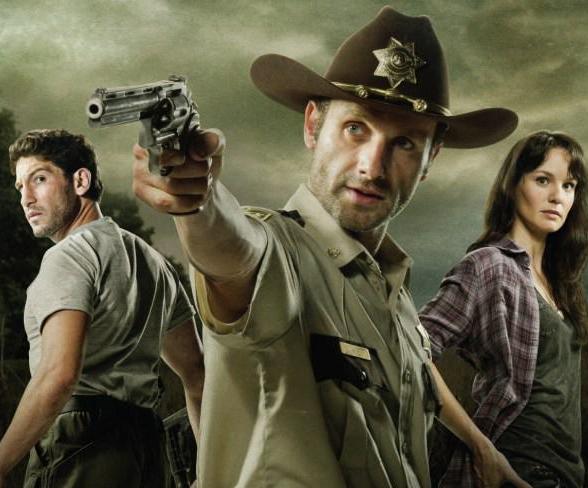
Who would you rather have on your side: Rick, or Shane?  If you're not sure what I'm talking about, take a few hours or days to watch the first two seasons of The Walking Dead on Netflix.  The premise is simple.  Rick, the cop gets shot and falls into a coma.  During that time, the world comes to an end.  Zombies walk the earth.  He wakes up a few days later and has to make his way through the ravaged city, desperate for answers and to find his wife and son.  Meanwhile, said wife and son think Rick is dead and have come to rely on his best friend Shane to protect them.  Wife sleeps with Shane, Rick catches up to them.  Cue portentous music.

The television show, produced by AMC (probably the most innovative network on American television), is based on the series of graphic novels of the same name by Robert Kirkman, Tony Moore, and Charlie Adlard.  It follows the trials of a small band of people trying to escape Atlanta and make their way someone, anywhere, that's safe.  The dangers of the zombie apocalypse are exacerbated by the secrets each character possess, and the fault-lines dividing the camp.

That's the quick and dirty.  I recently caught up on the second season so I can jump into the third, currently airing.  I was struck by the dynamic between Shane and Rick.  Although Shane slept with Rick's wife--and even though Rick isn't exactly cool with it--he accepts that his family and Shane believed that he was dead.  It was one of those instances of forgiveness in extremis.  But the major contention that divides the two friends is the manner with which they deal with danger.  Shane sees danger in its immediate context: How it's a danger to the woman and child he believes he loves.  Rick sees danger in the context not only of the group he has become leader of, but also to the group's humanity and in regards to longer survival goals.  He sees survival as more than a zero-sum game.

They're both right.  Sometimes danger comes at you and you have shoot it in the head.  But other times are less black and white.  Highlighting the difference is the moral dilemma facing them both in the second season.  What to do with a prisoner they've saved/captured?  Shane understands from the beginning that they will probably have to kill the prisoner so that he cannot return to his own group and lead them to the small band of survivors Shane and Rick are both trying to protect.  From his perspective, killing the prisoner is the only option available to them.

But Rick sees the death in larger terms.  Not only does he want to protect the group, but the last shards of humanity they're all desperately clinging to.  He understands that the world they've inherited is cold and unfeeling, and with a child already succumbing to it, he wants to keep it as far at bay as possible.  But there's something else at play.  Rick understands that people are feeling, communal beings, and the connections we all form are just as important to our survival in crisis situations as the existential threats beating at our doors.  In a few words: We're more than the air we breathe.

So when the world ends, who do you want on your side?  Shane, who'll keep you breathing by doing everything possible, including leaving you to die if you become a burden to the group?  Or Rick, who will fight and sacrifice to keep you alive and offer you hope?  In the calm of your office (or wherever you're reading this) the answer seems simple.  I'd pick Rick, and most of the people seem to, and the writers of both the graphic novel and the television show seem to lean that way.  Shane, though, has definite advantages.  With the ruthlessness to get stuff done, he offers a viable means of surviving to the next day.

But I'm glad most people would pick Rick, because it offers us a method of preserving our humanity in the face of almost certain doom.  And that's reassuring.  Regardless, I'm excited for season three.

Who would you pick?  Rick the strategist, or Shane the tactician?  Let me know in the comments.

Monday, November 5, 2012

May Flights Of Angels Lead You To Sobriety . . . Or, Flight Review

Flight, directed by Robert Zemekis and starring Denzel Washington, is the story of William "Whip" Whitaker, an alcoholic who also happens to be a pilot.  I walked into this movie knowing very little, save what I'd seen on the trailers.  It looked like it was about a pilot who'd pulled off the miraculous crash-landing of his plane, a la Sully Sullenberger.  The trailer made it sound like the pilot was then going to be the target of a malicious government smear campaign to discredit his heroism and miraculous flying.

That's about the opposite of what this movie is about.  It's about addiction, redemption and the dark night of the soul.  And then its about the leap of faith that moves an alcoholic from his addiction toward salvation.  The religious themes in this movie were abundant, perhaps even overbearing, and it often meandered toward maudlin.  But at its core it's a movie about a man coming to terms with an addiction in the face of intense scrutiny.

Maybe all addicts feel this way.  I have to imagine that the lying and repression makes every question by a concerned loved one feel like an interrogation, and the well-intentioned inquiries are as intrusive as a horde of paparazzi.  So framing the story of alcoholism in the light of a plane crash is a good way of looking at how alcoholics come to terms with themselves and the consequences of their addiction.

As Zemekis's first live-action movie since Cast Away, it is ably directed, with fine work from everyone involved.  But the tone of the movie is simply off. So many of the appalling actions made by Whitaker are presented in a humorous and down-right comedic tone, so that the audience is left wondering what the big deal was anyway.  Binge drinking, snorting coke, driving drunk, flying drunk, are all presented with a humorous undertone so that when the eventual rock-bottom is hit, we're left wondering why.  Whitaker never seemed to have experienced his dark night of the soul; his leap of faith is made for the benefit of the audience, not the character.  This oddly inverted tone left me feeling uncertain, and at times apathetic.

Ultimately, the movie is a character-driven examination of one man's path toward redemption which meanders in places, is hilarious in some places (especially the use of secondary and tertiary characters--the chain-smoking cancer patient, John Goodman as a drug dealer, and Don Cheadle's deadpan delivery.)  Nevertheless, it was a movie that was heavy-handed, sentimental and sometimes dry.  Overall, it was an uneven job on Zemekis's part, but a fine addition to Denzel Washington, Don Cheadle, Melissa Leo, Bruce Greenwood, Kelly Reilly, and John Goodman's collective oeuvre.

I'd recommend this movie to a friend.

World Fantasy Award Winners


The winners of this year's World Fantasy Award were just announced. 

The competition was tough this year; up for best novel was the Hugo award winning Among Others, but Jo Walton, and the soon-to-be-a-movie Those Across the River by Christopher Buehlman. 

Heavy hitters like G.R.R. Martin and Stephen King were also represented, Martin for his latest addition to the Game of Thrones and King for his time-travel/alternate reality 11/22/63. 

But the winner was an obvious choice for me this year.  I've blogged about it already, raved enough elsewhere, and couldn't be more pleased that Osama by Lavie Tidhar was chosen as the winner of the World Fantasy Award.