By Steven McLain
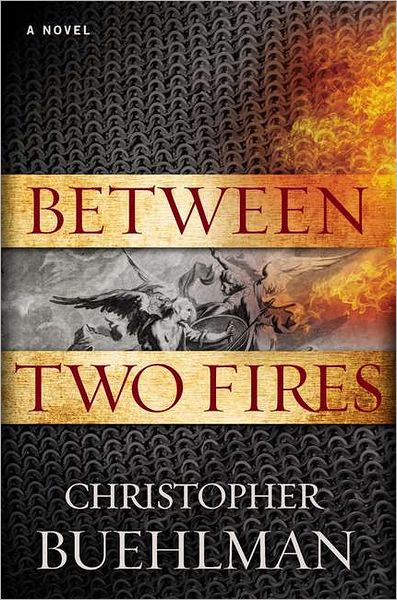
War, once more, has erupted in Heaven. Not content with their place in Hell, the fallen angels have once more made war against Heaven. But in their struggle, they have not yet been able to pierce the walls of Heaven and instead have turned their eyes on the Creation of the Lord. Caught between Heaven and Hell, the sons of Adam, and daughters of Eve, are left undefended as the angels struggle to defend their realm. Because in Christopher Buehlman's sophomore novel
Between Two Fires, the Lord does not avail Himself to defend either His realm, or His creation.
 |
| Battle of Crécy |
In an attempt to usurp the Lord's place, the fallen have turned their attention to the earth, and have seemingly unleashed the Four Horsemen of the Apocalypse: Death, Famine, Pestilence and War. But Buehlman does something unique with this oft-turned trope: Instead of setting his novel in the present and drawing analogy to wars and rumors of them,
Between Two Fires is set in the fourteenth century France. During the height of the Hundred Years War, he dares suggest that the horrors of Crécy and the pestilence of the Plague that nearly destroyed Europe in 1348 were the work of nefarious agents, as many suspected, and in fact believed.
The story follows a knight errant, a waif, and a priest whose entire village has been emptied by the plague. Buehlman doesn't suffer modern sensibilities. The coarseness of the fourteenth century abounds. Feudal, paternalistic, harsh, we're treated to an intimate portrait of a world we should be glad has left us behind. Beginning with the near rape of our fourteen year-old hero, Delphine, we're immediately greeted to the sight of a village decimated by bubonic plague. Defending Delphine from the depredations of his wandering brigands, our knight Thomas grudgingly takes her under his wing, or she takes him under hers, as she can see angels.
 |
| Joan of Arc, 1485 |
This is not the first time we've heard of French girls heeding the advice of angels and saints. Joan of Arc would lead her people to victory against the English a few years later and galvanize French nationalism. But against charges of heresy, Joan fared worse than Delphine, who in Buehlman's novel, has been inspired to correct much of what the fallen have undone. That journey, part
Canterbury Tales and a great deal of Barbara Tuchman's
A Distant Mirror (to which he pays homage in the acknowledgements), leads through Paris, many smaller towns and villages, and eventually ends in Avignon. Along the way, Thomas battles aberrations, demons and monstrosities of various sorts, both mortal and immortal. We see the inhumanity of antisemitism, the prejudice and superstition of an age before Enlightenment, and the horrors of a world in which government is as often predator as it is protector of the people.
 |
| Palais des Papes, Avignon |
Unfortunately, the novel disintegrates roughly three-fourths through, as Delphine and Thomas arrive at the gates of Avignon. The threat posed by the demons is clarified, but the menace is lacking. Somehow, imagining demons as the ultimate source of our own worst excesses seems shallow, and though we'd expect
deus ex machina in a story that features angels, demons, and the Lord as characters, somehow the climax lacks the divine grandeur one would expect. The denouement, however, is poignant, and underscores the redemptive theology of Catholicism at that time, the same theological thread which would wind through many facets of Protestantism in later centuries.
Ultimately,
Between Two Fires is a book that demands a reasonable knowledge of Medieval history, and particularly the vagaries of the Hundred Years War. For instance, one must know that schism in the Church had induced the Pope to relocate to Avignon; that Crécy was the first instance of the domination of the English longbow on French battlefields, and not the storied fields of Agincourt; and, especially, the sometimes strange feudal relationship between villein and seigneur. These details definitely reveal much of what Buehlman cannot take the time to say, and I wonder how someone without that knowledge would read this book.
While I would definitely recommend this book, I would not recommend it universally. Those with an interest in the Middle Ages, or have some background knowledge, will find it thoroughly enjoyable. I cannot speak to the pleasure others will garner. So, mixed recommendation.