Showing posts with label H.P. Lovecraft. Show all posts

Wednesday, November 21, 2012

Me, Myself and H.P. Lovecraft . . . Or, The Eldrtich World of Lovecraft Tributes

H.P. Lovecraft might be the most influential American author of the twentieth century that you've never heard of.  Chances are you know people he's influenced, from Stephen King to Mike Mignola.  But chances are equally great that if pressed, you might not really know Lovecraft from either of those two.  Lovecraft is a strange case of fame come too late.  In this case, his fame is almost entirely posthumous and due in large part to the efforts of friends after his early death to preserve his writing.

The most obvious reason you've never heard of Lovecraft--or if you have heard of him, never read him--is the dense, archaic prose in which he embeds his horrifying tales of the strange and eldritch.  Indeed, that prose is difficult for the uninitiated to fathom, and the threshold accordingly high.  Yet those who do plumb the depths of Lovecraft come away better for it; or at the very least, with a new perspective of humanity's role in the universe.

Because Lovecraft is the first author of the twentieth century.  What I mean by that is the H.P. Lovecraft was the first author to fully understand the anomie of the twentieth century as science removed humanity from its lofty position in the heavens.  The culture dissonance that would occur after the First and Second World Wars was preluded by H.P. Lovecraft.  His fiction divorces human beings of universal importance; to Lovecraft the universe is cold, and inhabited by beings so vast and powerful that their actions cannot even be described as malicious or aggressive.  They simply are, and to confront them is to beard madness.

For all of these reasons (and probably more) Lovecraft has made something of a comeback in the last few decades.  He's always enjoyed cult status, but the fall of the Soviet Union made him much more salient.  The rise of international terrorism and the absurd turn we've made in light of 9/11 makes him all the more relevant.  The mortgage crisis of 2008.  The Occupy Movement.  All are Lovecraftian.  Because he's all about forces beyond our understanding, and he knows that to confront them is to fall victim to madness.

Writers have paid tribute to Lovecraft for decades, but much of the earlier work focused on expanding the mythos Lovecraft had created.  August Derleth, who did the most to rescue Lovecraft from obscurity, also traded on the name and expanded the world that Lovecraft created, embedding his own moral and theological beliefs into a universe that Lovecraft understood to be largely amoral. 

Recently, I have had the pleasure to read two different takes on Lovecraft, and the idea of an uncaring, hostile universe.  The first was given to me as a gift, and features Lovecraft in historical settings.  Historical Lovecraft, published by Innsmouth Free Press, features 26 tales divided into roughly three historical epochs: Ancient history, the Middle Ages, and Modern Times.  Very much in the vein of stories initiated by Derleth, each story varies in how closely it hews to Lovecraft.  Some are deeply disturbing, and remind us that the universe is cold and dark; others feel like modern horror.  While you could make the argument that the modern zombie fascination is very Lovecraftian, the menace and the malevolence are simply lacking.  Nevertheless, disentangling Lovecraft from the early twentieth century New England in which he wrote allows us to see the broader implications of his mythos. 

The second collection of short stories is a collection of Lovecraftian science fiction.  The transition from Lovecraftian horror to science fiction is an easy one to make.  Alien seems so much like it came from Lovecraft's own imagination that one has to wonder if HR Giger and the writers (Dan O'Bannon and Ronald Shusett) weren't channeling his spirit.  Initially considered a horror movie, Alien has come to be regarded as seminal in a new style of science fiction in the universe is--you guessed it--cold and amoral; daring to look it in the eye may reduce to you a gibbering mass.

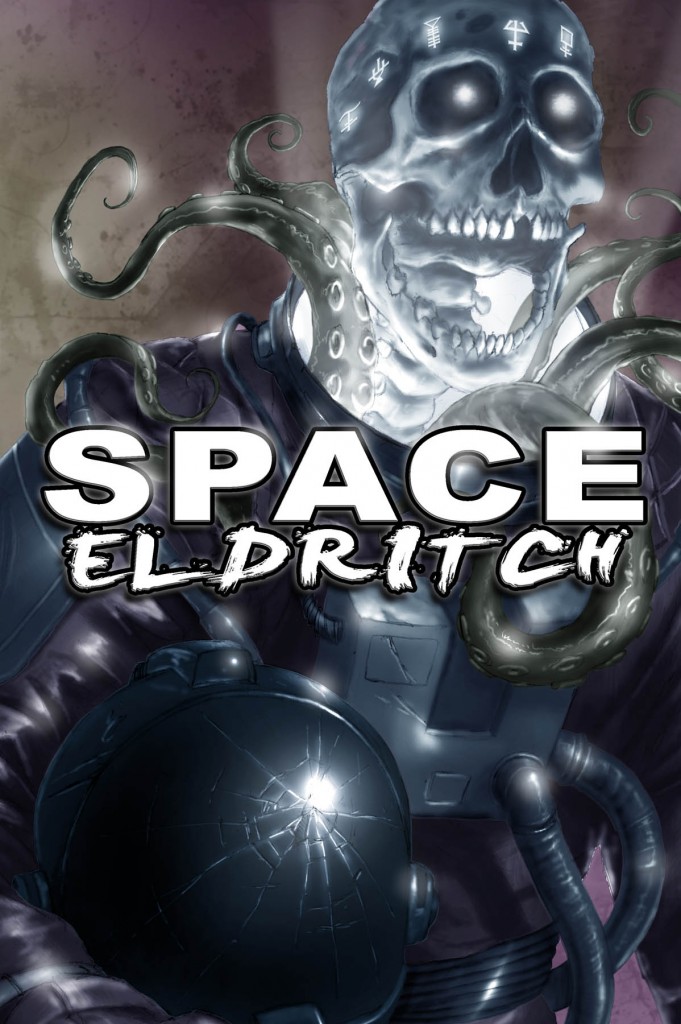
Space Eldritch, published as an ebook (with a print version on the way) by Cold Fusion Media, takes a somewhat different approach.  Narrower in scope than Historical Lovecraft, the stories themselves are more intimate and less disturbing.  Science fiction owes a debt of gratitude to Lovecraft, and it shows in the writing of these pieces.  Often paying tribute to pulp sensibilities as much as to Lovecraft, except for a few touchstone Lovecraftian images, few of the pieces seem to disentangle themselves from the science fiction tropes we've become familiar with.  Both Mission to Mars (the godawful travesty featuring Gary Sinise and Tim Robbins) and Paul Verhoeven's Total Recall make appearances when we encounter something menacing lurking beneath the Martian soil (to be fair, however, Philip K. Dick's influence is just as ubiquitous in science fiction as Lovecraft is in horror.) 

Ultimately, this collection of stories simply lacks the menace of Lovecraft.  Maybe that's a product of our times.  We've become used to the idea that science has all the answers.  Or at the very least, that answers exist.  Lovecraft was less interested in that than in examining a universe beyond human ken.  And I think the authors of Space Eldritch have failed that test.  They're fully a part of the modern zeitgeist.  Maybe we can't go back, but I like to think that Lovecraft is still viable and an important perspective in these uncertain times.

Tuesday, September 11, 2012

Weird Stories . . . I Have Never Read "The Call of Cthulhu"

summeroflovecraft.com
The title isn't entirely right.  I have read "The Call of Cthulhu" by H.P. Lovecraft; but not until very recently.  Like, within the last week.  There's something really strange about not having read this story yet declaring that I enjoy reading Lovecraft.  Moreover, there's something really odd about saying that I like the so-called "weird" genre without having read the most famous story within the genre.  I chalk it up to not liking what's popular.  I avoid Oprah's book club.  I try not to read whatever happens to be on the New York Times bestseller list (or at the very least I try to read it before it hits that point.)  Maybe it's because I'm a snob and I actively disdain what everyone else enjoys on the assumption that it's kitsch, or low-brow.  That last assumption based on the assumption that the more people you stick in a room, the lower the IQ tends to be.  This of course is the opposite of the Wiki movement and much of the collaborationist tenets of the forthcoming age.  But I digress.

H.P. Lovecraft is someone whose works I have read, on-and-off, for the last decade and a half.  I have several collections of his work, but I came to them rather obliquely.  That is, I remember seeing a collection in the bookstore and feeling a little off-put by the cover art.  It was weird; it was frightening.  It was probably something I wanted to avoid. 

But then I got into Stephen King in a big way, and started hearing about this guy named Gaiman.  I started reading the Sandman comic series when it was released as a trade paperbacks, and I really enjoyed it.  So when I heard that both were heavily influenced by H.P. Lovecraft I figured he was someone whose work I should probably try. 

The onus of "pulp" still hovered over him, though, and I felt my snobbery rising.  I tucked the book with the weird cover under my arm and hoped no one saw what I had purchased.  I took it home, and I read a couple stories. 

And I didn't like them.

At that time I was unaware of his different periods of writing, what we'd call "seasons" if he were a painter of any renown.  But as it was, there are definite periods in Lovecraft's life that reflect both his ability and his inclinations and I picked a book which highlighted his younger years and his less-mature works.  I have the feeling that I chose that book because the cover was less-weird than the rest, but come what may.  Regardless, I was uninterested in reading further and I had the vague sense of snobbery confirmed; people who liked this guy were just unenlightened. 

So a few years went by, and I had the sense that I'd missed out on something there.  People were talking about Lovecraft in a way often reserved for Tolkien, or Lewis.  He was mentioned in circles that included Edgar Rice Burroughs and Robert E. Howard, whose Conan series and Solomon Kane (which, unknown to me until I wrote this post, was made into a movie), I both knew and admired.  Also about this time, I heard about the Lovecraft Film Festival here in Portland and began to understand that, indeed, I had missed something. 

My own writing of this time reflects the heavy influence of weird.  I was reading a lot of Shirley Jackson for writing classes, and Stephen King in my spare time and the early 2000s were simply a strange time to be alive.  Fiction of the time reflected the tension of a nation at war, and the uncertainty of an enemy who couldn't quite be pinned down.  Weird fiction became popular because the world had become weird.  In retrospect, it seems obvious that I should have read more Lovecraft, but I still didn't.

I read Machen, Algernon Blackwood, Lord Dunsany, Chambers, and others.  All the people that inspired Lovecraft, but I never read Lovecraft, still haunted by stories like "Dagon."  Arthur Jermyn was moving in a deeply subtle way that I still haven't identified--its undertones of racism are almost too odious to dwell on.  But stories like Nyarlathotep and Herbert West (a kind of take on Frankenstein) are too beautiful, and too fun, to easily dismiss.  But I'd never read "The Call of Cthulhu."  Or "Colour out of Space."  Or some of his best known works which best exemplify his philosophy and style.

Until this week.  I'm not sure why this week seemed the most appropriate time to sit down and read those seminal works.  It's obvious that some of the themes in "Cthulhu" are reflections of "Dagon."  Nevertheless, he tells a finer story in his later years, with a surer hand.  The evocation of the weird and terrible is deft and wielded by a master's hand.  I was surprised how much I enjoyed these stories, and continue to find myself surprised as I read on.  "Whisperer in Darkness" is next.

What's your favorite Lovecraft story?  How did you come to find weird fiction?  Share your story in the comments.

Thursday, August 16, 2012

H.P. Lovecraft and Robert E. Howard . . . Embarrassing Middle Names

H. P. Lovecraft and Robert E. Howard

Last night I found two great collections of both Lovecraft and Howard's works.  Both are electronic editions of the collected works of Lovecraft, and the collected Conan stories by Robert E. Howard.  Howard wrote other things, but this was the first time that I had seen all of the Conan stories in a single place.  Normally, they're broken up into separate volumes and at $15 a pop can add up pretty quickly.  Barnes and Noble has a delightful collection of Lovecraft's stuff, and even though it has a beautiful leather cover I can't seem to work up the hutzpah to plop $30 down on it.  On my Kindle, however, each went for less than $3--the Conan collection itself was less than a buck.

So what does that mean, other than that I am a tightwad over really inconsequential things?  First, it's an indictment of the way publishers market and sell their books.  Second, its an interesting meditation on the way in which works of fiction are consumed.  Well, let me clarify that.  It's an interesting meditation on the way in which written works of fiction are consumed.  Both of these works were published in the early twentieth-century.  Some of Lovecraft's works are old enough to have passed into the public domain (though I think Miskatonic or Arkham keeps the copyright alive).  Conan is a part of the modern gestalt.

On some levels, this means that Cthulhu and Conan belong to the public in a way that most modern writers have a hard time wrapping their head around.  J.K. Rowling (another author known only by her last name.  I'm sensing a theme) understands this, and is probably a good example of a modern author who has allowed the public to both consume and take ownership of her works.  She knew when to let go.  George Lucas (no mysterious middle initial here) is probably the best example of the opposite way of going about it.  He maintains such tight control that his fans have actively begun working against him

Both of these phenomena converge in a hazy middle ground between the authorial instinct to conserve their creation, and the consumers' instinct to embrace and propagate beloved story.  This comes out in the medium itself.  At least within publishing, there are certain overhead costs that simply must be paid.  Printing, storage, and shipping are the few that comes easiest to mind, but certainly they are not alone.

I remember hearing with almost rapturous delight about the coming age of the e-book.  Certainly if we are not already in it, we can just see it over the horizon.  And it casts a long shadow indeed.  We were told to expect that publishers would slash their prices, and that the heady forces of the free market would drive prices to unfathomably low levels.  Strangely, that never occurred.

Maybe it wasn't so strange, after all, though.  Maybe it's something like the George Lucas phenomenon.  Is it possible that publishers are holding on too tightly?  I have a feeling it's more than possible, it's probable that the publishers are squeezing their fists.  And we don't need Princess Leia to tell us that tighter they close it, the more star-systems will slip through their fingers.  Or book sales.  You get the point.

Don't get me wrong.  Unrestricted consumerism never solved any problems, either.  Letting the horses have a free reign is nice for a weary horse, but dropping the reigns entirely means you'll probably plummet over a edge cliff when something spooks them.  Market forces are a lot like that, and publishers need to figure out that lowering prices (but not slashing them) is the best way to bring back jaded and weary consumers.  The stunning success of Fifty Shades of Gray (I feel a little filthy dignifying them with italics) proves that point.  Initially published entirely online, they were adopted as print editions to satisfy the decreasing, but still substantial, niche of readers who will only partake in masses of battered wood pulp splattered with toxic chemicals.

I have to admit, I privilege the printed book over the electronic.  But gradually, as the ease of consumption increases, I have turned much more readily to electronic editions.  Which makes me suspect that books aren't dying, just printed books.

What do you think?  Like some E?  E-book that is.  Let me know in the comments.


As a short addendum.  It was really hard finding a picture of anything relating to Robert E. Howard and Lovecraft in the same picture.  How great would a painting of Conan vs. Yog-sothoth be?