Showing posts with label Christopher Buehlman. Show all posts

Tuesday, November 20, 2012

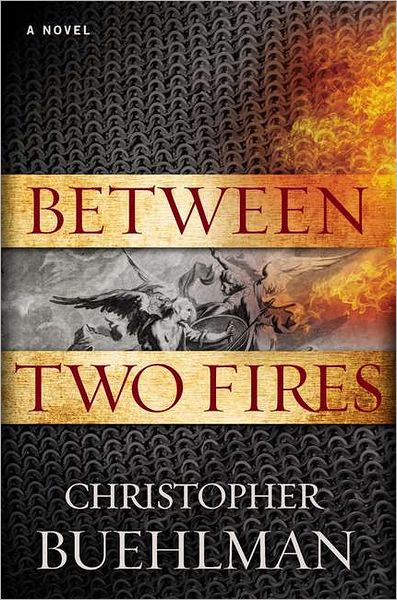
Between Two Fires Review

By Steven McLain

War, once more, has erupted in Heaven.  Not content with their place in Hell, the fallen angels have once more made war against Heaven.  But in their struggle, they have not yet been able to pierce the walls of Heaven and instead have turned their eyes on the Creation of the Lord.  Caught between Heaven and Hell, the sons of Adam, and daughters of Eve, are left undefended as the angels struggle to defend their realm.  Because in Christopher Buehlman's sophomore novel Between Two Fires, the Lord does not avail Himself to defend either His realm, or His creation. 

Battle of Crécy
In an attempt to usurp the Lord's place, the fallen have turned their attention to the earth, and have seemingly unleashed the Four Horsemen of the Apocalypse: Death, Famine, Pestilence and War.  But Buehlman does something unique with this oft-turned trope: Instead of setting his novel in the present and drawing analogy to wars and rumors of them, Between Two Fires is set in the fourteenth century France.  During the height of the Hundred Years War, he dares suggest that the horrors of Crécy and the pestilence of the Plague that nearly destroyed Europe in 1348 were the work of nefarious agents, as many suspected, and in fact believed.

The story follows a knight errant, a waif, and a priest whose entire village has been emptied by the plague.  Buehlman doesn't suffer modern sensibilities.  The coarseness of the fourteenth century abounds.  Feudal, paternalistic, harsh, we're treated to an intimate portrait of a world we should be glad has left us behind.  Beginning with the near rape of our fourteen year-old hero, Delphine, we're immediately greeted to the sight of a village decimated by bubonic plague.  Defending Delphine from the depredations of his wandering brigands, our knight Thomas grudgingly takes her under his wing, or she takes him under hers, as she can see angels. 

Joan of Arc, 1485
This is not the first time we've heard of French girls heeding the advice of angels and saints.  Joan of Arc would lead her people to victory against the English a few years later and galvanize French nationalism.  But against charges of heresy, Joan fared worse than Delphine, who in Buehlman's novel, has been inspired to correct much of what the fallen have undone.  That journey, part Canterbury Tales and a great deal of Barbara Tuchman's A Distant Mirror (to which he pays homage in the acknowledgements), leads through Paris, many smaller towns and villages, and eventually ends in Avignon.  Along the way, Thomas battles aberrations, demons and monstrosities of various sorts, both mortal and immortal.  We see the inhumanity of antisemitism, the prejudice and superstition of an age before Enlightenment, and the horrors of a world in which government is as often predator as it is protector of the people. 

Palais des Papes, Avignon
Unfortunately, the novel disintegrates roughly three-fourths through, as Delphine and Thomas arrive at the gates of Avignon.  The threat posed by the demons is clarified, but the menace is lacking.  Somehow, imagining demons as the ultimate source of our own worst excesses seems shallow, and though we'd expect deus ex machina in a story that features angels, demons, and the Lord as characters, somehow the climax lacks the divine grandeur one would expect.  The denouement, however, is poignant, and underscores the redemptive theology of Catholicism at that time, the same theological thread which would wind through many facets of Protestantism in later centuries. 

Ultimately, Between Two Fires is a book that demands a reasonable knowledge of Medieval history, and particularly the vagaries of the Hundred Years War.  For instance, one must know that schism in the Church had induced the Pope to relocate to Avignon; that Crécy was the first instance of the domination of the English longbow on French battlefields, and not the storied fields of Agincourt; and, especially, the sometimes strange feudal relationship between villein and seigneur.  These details definitely reveal much of what Buehlman cannot take the time to say, and I wonder how someone without that knowledge would read this book. 

While I would definitely recommend this book, I would not recommend it universally.  Those with an interest in the Middle Ages, or have some background knowledge, will find it thoroughly enjoyable.  I cannot speak to the pleasure others will garner.  So, mixed recommendation.
Friday, November 9, 2012

How To Be Awesome and Have Fun Doing It . . . Or, Weekend Round-out

I've decided that Fridays are going to be devoted to a brief synopsis of cool things that happened in the last week, or cool things to do over the weekend.  These could be up-coming, or recently released movies, or movies you just plain need to see; these could be upcoming author signings; these could be books I'm currently reading and excited about . . . the list continues!  But regardless, it's a quick and easy way for me to let you know what happening in the wider world of awesome.

First.  Go see Argo.  You can read my review here, but suffice to say it's my favorite movie out at the moment.

Then, go see Skyfall.  It's the 27th James Bond movie and it's been getting incredible reviews.  It's on my agenda this weekend.

I'm in the middle of Christopher Buehlman's Between Two Fires and so far it's great.  It's the story of an excommunicate knight, a priest and a young girl who sees angels trying to make their way in fourteenth-century France.  Set during the Hundred Years War and not far on the heels of the disaster at Crécy, it has everything you could want in a historical fiction, but it's not entirely historical fiction.  It's also horror, fantasy and that weird blend of Gothic that Buehlman did so well in Those Across the River.

I also have The Twelve by Justin Cronin on my shelf.  The sequel to The Passage, it continues the story of the end of the world after a viral plague has turned most of the population into vampires.  The Passage, with its sudden and inexplicable conclusion distressed me enough to recommend no one read that book, but I've mellowed in the meantime, and now I recognize just how awesome (most) of the book actually is.  Now that the second in a planned trilogy has been released, I think you should give it a look.

Also, since the buyout of Lucasfilm to Disney has sent shock waves through the geek community, I thought I'd temper that with news of the merger of Random House (who publish Christopher Paolini, Dan Brown, and Jean Auel, among others), and Penguin Group (who publish titles by Patricia Cornwell, Tom Clancy, Laurel K. Hamilton among others, and who recently published No Easy Day), two of the largest book publishers in the world.  They're hoping to use their combined powers for good, offering brick-and-mortar stores a new vitality.  While they're not the juggernaut either Disney is, or Lucasfilm was, they nevertheless come in at a whopping $4 billion in yearly profit; that's some clout to throw around, and the resources a publisher needs to make some innovated but risky decisions.  I'm looking forward to seeing what they come out with.

And since I seem to be on a zombie kick this week, the new trailer for "World War Z" has been released to the internet.  World War Z is the documentary-style book written by Max Brooks (of The Zombie Survival Guide fame) that details the last days of humanity, and the reconquest of the planet by small pockets of human beings.  Based on the trailer, it seems like that documentary style has been completely abandoned; instead we're treated to the usual paint-by-numbers action flick starring Brad Pitt.  The movie does, nonetheless, depict some truly terrifying zombies.  Still excited to see the movie, but not quite as excited as I was two years when I heard about this being made into a movie.  Take a look:


Monday, August 27, 2012

Those Across the River Review

Fleeing the North in disgrace, WWI veteran and failed academic Frank Nichols and his soon-to-be wife Eudora, arrive in a tiny Georgian hamlet where Frank has just inherited the home of his recently deceased aunt.  Under the strict injunction to sell the house and absolutely not to move to Whitbrow (the aforementioned tiny hamlet), Frank does exactly the opposite.  But haunted by the specter of war, and the stigma of both cuckoldry and adultery, Frank takes this opportunity to be heaven-sent.  It doesn't hurt that just across the river is the ancient Savoyard plantation, where his great-grandfather was known to have treated his slaves so inhumanely, that they eventually rose up and slaughtered him.  Hoping to segue family tragedy into a book which might serve as passport back to his academic career, Frank is lured across the river and confronted by memories that simply refuse to die.

This very basic summary hardly does the book justice.  First of all, this is a supernatural horror story, and is currently up for nomination to win the World Fantasy Award.  Second, it deals with subject matter far more literary than this genre is used to.  The mental wounds that Frank suffered in the trenches of WWI still torment him; moreover, from the outset we're informed that while he's a nice guy, he's not above sleeping with another man's wife.  From this fragmented moral landscape, we're also offered a piquant reminder of the suffering and inhumanity of slavery.

This book is remarkably smart, not only in its subject matter, but also in the way that it deals with the persons of Frank and Eudora Nichols (as they eventually do marry).  Told in the first person, however, it necessarily focuses on his triumphs, defeats, fears and the quotidian tragedies that comprise human existence.  It doesn't surprise me at all that this book has been picked up to be made into a movie, directed by Tod "Kip" Williams, who directed Paranormal Activity 2.  Commentators have noted that Christopher Beuhlman writes like a combination of Flannery O'Connor and Stephen King, which is not an inapt comparison.

The singular flaw in the novel, however, comes late in the second act, and continues throughout the third act.  Once the mystery is revealed, and mortal lives are placed in danger, Beuhlman fails to utilize the wealth of characterization he has developed in the previous act.  Indeed, the first act reads so well because of the deeply characterized human beings who inhabit the fictional world of Whitbrow.  Their deaths, when they come are tragic, but we never have a sense of who they are under pressure; indeed, by the start of the third act they have simply disappeared and two new characters are introduced to help our protagonist win the day.

But this shortcoming is minor, and really only occurred to me after the fact.  It hardly detracts from the overall story.  It kept me up well past my bedtime and I can't say that I minded.  In fact, this might be my favorite book of the year and I heartily recommend it.  


Thursday, August 9, 2012

2012 World Fantasy Award Nominees


Check it out!  The World Fantasy Award Nominees were just announced.   

A Dance with Dragons by G.R.R. Martin made the cut, as did Among Others by Jo Walton.  If you'll recall, both were nominated for the Hugo award this year.

Stephen King makes an appearance, which shouldn't surprise too many people (well, maybe it will because he's not particularly well-known for his fantasy works).

The real surprises are the books that haven't made much of a splash in the genre world.  Osama, by Lavie Tidhar seems like something to keep an eye out for, as well as Those Across the River by Christopher Buehlman.  

I'll let you know what I think but until then, post your thoughts in the comments.