Showing posts with label Star Wars. Show all posts

Thursday, July 25, 2013

The Naked Soul . . . Or, Pathos and Catharsis In Film

What Dreams May Come always makes me cry.  If you haven't seen it, you need to.  Based on a Richard Matheson story (the same guy who wrote "I Am Legend," "The Shrinking Man," and "A Stir of Echoes") the film stars Robin Williams as a man whose love for his wife transcends Heaven and Hell and who turns his back on paradise to save her.  It is in my top ten films of all times, a list which includes tear-jerkers like Moulin Rouge and Top Gun.

In fact, as I reflect on my favorite movies, I realize that many of them contain moments of extreme pathos, moments when heroes fail, beloved characters die, or when someone makes a difficult decision which necessarily ends in tragedy.  Often the movie ends with success, but the journey is an emotional roller-coaster that makes the ending earned.  Earning the punchline is the hallmark of any good joke, and in film, stories, or any kind of narrative, the conclusion must be earned.  Otherwise the movie feels like a waste of time, regardless of the money poured into its special effects.

On that note, I've given some thought to what generates pathos -- what gives a story emotional depth and generates sorrow, pity, sympathy, or tenderness toward a character.

The first, and most vital ingredient, is a goal.  A concrete, identifiable goal is what defines a protagonist.  Think about Luke Skywalker: He wants to join the Rebellion to destroy the empire.  First, he has to leave his home, but his Aunt and Uncle won't let him.  After he receives his call to action by Obi-Wan, he departs on a mission to find the rebellion and deliver R2-D2 to them.  Once he's accomplished that mission, and found the rebellion, his initial goal is achieved.  But he still has to destroy the empire, symbolized in Episode IV by the Death Star.  Spoilers!  He accomplishes his goal.  But in the process he loses something important to him -- his mentor and friend, Obi-Wan Kenobi.

Just as important, Obi-Wan is killed while attempting to accomplish his own goals -- a goal he has in fact almost completed.  After disabling the tractor beam so that the Millennium Falcon can escape, he interposes himself between Darth Vader and Luke, enabling everyone to escape.  His sacrifice is what accomplishes that goal and we feel Luke's sorrow by being sad ourselves.

Writers sometimes talk about try-fail cycles.  In a traditional three-act structure, you see that nice arc that plunges at the end of the second act, and is completed in the third.  The protagonists concrete, identifiable goal is important because at the end of the second act, the protagonist should be as far as possible from accomplishing that goal.  In Star Wars the second act ends with Obi-Wan's death because he is Leia's "only hope."  With him gone, hope is gone, until we realize that now Luke has the Force and can destroy the Death Star, which, remember, was Luke's goal all along (even if he'd yet to discover it).

But for a reader or viewer to feel as though something has been accomplished, the characters cannot win every time.  In fact, each time they attempt something they should fail somehow.  When Luke goes in search of R2-D2, he's attacked and needs to be rescued.  Trying to feel Tatooine, Luke and Obi-Wan are interdicted by imperial Star Destroyers, they escape but when they reach Alderaan they are capture by the Death Star and so and so on.  They try, fail, have some success that enables them to try something else, they fail at that, try something else, and so on until the movie ends in victory.

Or consider Top Gun.  Maverick has only one goal: To be the best.  In the movie, this is symbolized in the concrete, identifiable goal of winning the Top Gun trophy.  We see him fail constantly in the classroom, in the air, and he is farthest from his goal just after Goose dies and he threatens to quit the program entirely.  Though he does not accomplish his goal of winning the trophy, we're offered a proxy goal of winning Ice Man's respect in the final battle with Soviet MiGs.

We as viewers feel these moments as deeply sorrowful because they advance both the plot and interfere with the protagonist's ability to achieve his concrete, identifiable goals.

The other form of pathos inducing action is the Noble Sacrifice in which a beloved character (usually other than the protagonist) sacrifices himself to save the protagonist, or our band of plucky heroes.  (Noble Sacrifices for abstract ideas or populations are much less noble because the viewer has difficulty developing affinity with abstract ideas or populations -- consider Armageddon in which Bruce Willis sacrifices himself for Ben Affleck: Though you could argue that he sacrifices himself to save the planet, it is clear that he does so in order to ensure his future son-in-law will survive to marry his daughter.  Or think about Neo choosing Trinity over humanity.)  In such cases it helps if the threat is external and has a definite end-point.  The classic is a ticking time bomb (such as the Genesis Device in Wrath of Khan, or someone diving on a grenade).

The final example I can think of is one of inevitability.  The protagonist cannot win.  Death is inevitable.  These cases, like British Officers on the Black Watch, teach us how to die.  In Deep Impact, facing the end, Tea Leoni's character stands with her father at the edge of the world and meets death with restraint and stoic courage.  The choice is what matters and we feel a profound sorrow in the realization that death is inevitable and that one day we may have to choose how to meet it.

In The Mist, Thomas Jane's character and his son finally escape the general store where they and most of the town have holed up; they've survived monsters in the mist and monsters of the human soul; but they've run out of gas and they can hear the monsters nearing.  With only enough bullets for his son, he makes the decision to spare his son a terrifying and gruesome death and shoots him in the head.  Death seemed inevitable and we're forced to make the same moral calculus as Thomas Jane's character.  Movies like this allow us to experience our own Kobiashi Maru every time we watch them, to challenge our own moral courage and our own values.

Wednesday, April 10, 2013

I'd Watch This . . . Or, Star Wars That's Cool

So, it's not often that I get excited about Star Wars anymore.  I'm interested to see what Disney has to offer, but I'm not excited.  This short anime by a fan makes me feel the same visceral pleasure that I experienced during my teens for all things Star Wars.  If Disney could reproduce this, I'd watch it.


Tuesday, March 19, 2013

Was the Death Star's Destruction an Inside Job? . . . Or, Luke's Change

Parodies of silly conspiracy theories feel too easy, but I love what Graham Putnam has done with this mockumentary parodying the truther video Loose Change.  Enjoy.


Monday, March 18, 2013

Populating the Multiverse . . . Or, Science-Fictiony People

Here's what I don't get: People.  In science fiction and fantasy.  The central conceit in all (or so near to all that the rest just sort of define the rule) speculative fiction is that people exist.  Now, in a lot of science fiction this isn't very problematic, since sci-fi tends to extrapolate from this moment and consider "what if?"  Where it gets kind of interesting in in fantasy.

Let's ponder.  Is Westeros Earth?  Nope.

Is  Randland Earth?  Maybe.

Is Middle-Earth our own Earth?  Probably not.

And on and on and on.  Which led me to wonder, where are the people coming from?  Are they following an evolutionary track that dictates that on any vaguely Earth-like planet there will be (mostly Anglo-Saxon looking) bipeds wandering around, mostly speaking English?  Mostly adhering to some vaguely Anglo-Saxon tradition? 

Probably not.

The first response is that it doesn't matter.  And it probably doesn't.  But these characters are our characters.  They represent people as we understand them, with many of the same cultural assumptions built into their own culture.  Major departures (I'm looking at you Neil Stephenson) include a rich cultural milieu that is difficult to get into, and characters who are difficult to empathize with.  So most fantasy includes people pretty much the same as you, or me, or our neighbors.

It sort of makes me wonder if all fantasy is just science fiction within the multiverse.  Remember those Ewok adventures?  The ones with the family that crash-lands on Endor and have to fight off rancor and evil witches?  They're pretty campy, but I remember them fondly.  What I remember most clearly is that though we're expected to understand these movies were set in a science-fictiony universe, there were witches, castles, and monsters.  But by slapping "A long time ago, in a galaxy far, far away . . . " we come to accept everything as falling under the umbrella of infinite universe = infinite variety.

So maybe, this is how it happened!

First, "A long time ago, in a galaxy far, far away . . . " the first human beings evolved in a rich milieu of diverse cultures, species and deeply steeped in a mystical energy field that allowed them experience the universe in a much more empathetic way.  In time, they developed space-flight, left their own galaxy, and spread throughout the universe.

In time they reached a medium aged, medium bodied spiral galaxy that looks suspiciously like spilled milk from the inside.  There, they settled a world and called it Earth.  (SPOILERS!)  But on that planet, they developed a race of cybernetic beings that eventually rebelled; nuclear war ensued and our intrepid human beings were forced to flee and colonize twelve planets where human civilization was rebuilt.  In time, they built cybernetic beings that eventually rebelled, nuked all the planets of humankind, and forced a rag-tag band of human beings out into the stars, where eventually they joined forces with their cybernetic creations to repopulate a planet they re-named Earth.  But they'd already developed faster-than-light travel, and though their main ship was pretty trashed, they were able to use smaller craft to spread throughout the universe.

Where eventually they created a system of stargates!  They spread throughout the galaxy, embedded the myths of the Twelve Colonies everywhere they went, and eventually returned to Earth, but because of whatever, decided this galaxy was pretty blase, and left for parts unknown.

But in all those other galaxies, they spread their culture (including Anglo-Saxonness, and the English language), but because of cultural degradation and environmental upheavals, some were lost and devolved to medieval technology.  And in a few really interesting cases, the transhumans even traveled to other universes, where the laws of physics are kind of wonky.  Or, since we know that any sufficiently advanced technology is indistinguishable from magic, maybe there are remnants of transhuman technology floating around that allow certain individuals to manipulate time and space in ways that mimic magic!

Seems reasonable to me.  Let me hear your thoughts in the comments below.

Tuesday, January 8, 2013

Mickey Mouse, You're My Only Hope . . . Or, Use the Force, Disney

By Steven McLain

Star Wars VII is in a pretty bad way.  First, J.J. Abrams said he wouldn't do it.  And now, Guillermo del Toro turned it down as well, saying he's way to busy making remakes of classic 80s cartoons.  Word is even Brad Bird won't touch George Lucas's world with a ten-foot pole.  And it makes me wonder just what the heck happened to turn Star Wars from the most critically acclaimed space fantasy of all time, a perennial favorite with viewers and the basis of rabid fan enthusiasm, into something that the best directors of our age don't even want to associate with.  It sort of has the feeling of that popular kid in high school who ten years later got fat and calls you up around midnight to come score chicks with him at the bar. 

I don't actually Episodes I through III on the debacle.  Yeah, they were pretty bad, but they didn't ruin the franchise as much as all those Clone Wars cartoons, licensed action figures and midichlorians did.  I don't want to get too deep into the muck with this, but George took a bold leap with his franchise; and sometimes bold leaps just turn into belly-flops.  The crass commercialization of the franchise, however, sunk it completely (to mix metaphors).  What used to be something original and compelling became just another gimmick to turn a buck--and people caught on.  Especially the people who like to make original and compelling cinema (though del Toro's recent Voltron remake makes me wonder). 

That's beside the point.  The point is that Star Wars isn't a franchise that people want to get behind anymore.  It's too restrictive, too puerile (case in point: Han shot first).  It's too childish (but once more, Peter Jackson seems to be doing okay making childish adaptations of beloved stories).  Regardless.  If Disney want to turn the ship of Star Wars around, they need a serious marketing coup.  They need to address the silliness of the franchise so that it appeals to the hard-core fans, while accruing new fans along the way.  I think they should start pounding out the books again, leverage some of their capital into fan films, or maybe even a series of webisodes that could boost interest and drive sales.  Somehow, Disney has to make us all believe in the Force again.


Tuesday, October 30, 2012

When You Wish Upon A Death Star

Disney today announced the $4 billion acquisition of Lucasfilm, including the apple of George Lucas's eye, the Star Wars franchise.  According to USA Today, the acquisition concludes a year-and-a-half pursuit by Disney of the lucrative franchise.  Disney announced that they would begin production of a new Star Wars film immediately, with a release date sometime in 2015, with subsequent films every few years.  Three years turn-around isn't that much in the high-stakes world of multi-million films, and the expectation of something staggeringly good has created a surge of interest among fans.

io9 has already speculated about the possible direction future films could take, and have offered several thoughtful ideas.  Among the ideas for Star Wars VII are stories set in the Thrawn universe, following the exploits of a fledgling New Republic battling the deeply embedded forces of Admiral Thrawn.  The books offer ties to the Clone Wars, and having the benefit of a pre-existing story, are a strong bet for future films.  Written by sci-fi master Timothy Zahn, they're also the first foray by Lucasfilm into the Star Wars universe post-Jedi, what's come to be called the Expanded Universe.  I think this is the best bet for Disney story-tellers if they're looking for something quick and easy, with the benefit of "canon" status.

Other avenues, of course, are available, and speculation ranges from a Darth Vader centered movie, to a Boba Fett spin-off.  While I would love to see something featuring Mara Jada (Luke's eventual wife in the Expanded Universe), I can't imagine that anything set within a few years of Jedi would have the appeal of later stories.  An Old Republic movie might be appealing.  Seeing the Jedi in their prime sounds fun on paper, but stories of political intrigue are dubious at best.  Lucas already tried that route and it failed miserably; trying to recapture the grandeur and opulence of the Old Republic might be beyond Disney's grasp--although, they've surprised me before.

While I'm excited to see Star Wars go off in a new directions, I'm of two minds about the whole thing.  First, we know that Star Wars without George at the helm is not a bad thing.  In fact, neither Empire nor Jedi were directed by him and Empire is considered the strongest of the three.  But George represents a locus of vision; it's his world and we're all just playing in it.  Although he's said that he'll stay on as a creative consultant, the machinations of corporate greed will play a much stronger role.  Maybe we'll get something good, maybe we'll get Episodes I, II, and III.  But the fact that Empire and Jedi didn't have George at the helm gives me hope that something good will come out of this.  I've been saying for years that a Star Wars absent George, given the love and attention only a true fan can give, would make for better Star Wars films.

*Update:  According to The Hollywood Reporter, Lucas is donating all that money to education.  Who would have thought?  I wasn't really expecting that.

What do you think?  Excited, worried, irritated?  I've got room for rants in the comments section.  

Friday, August 17, 2012

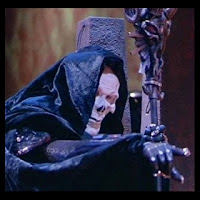
Best Sci-Fi/Fantasy Baddy . . . Skeletor v. Darth Vader


Skeletor Vs. Darth Vader

 https://blogger.googleusercontent.com/img/b/R29vZ2xl/AVvXsEj_h4Pl436sdZ-3GtwQ63Y1DnHq1JEVxNTRxZj31dJmSMtADMQL9u9OP7VbLDjA18NVt2Ee3ywI4uIMEmaZU6hPTm9rzMw1A0Ez4BxPANjVQipxSguCmx962EbbyzocrGoU2c_Y7P96IlY/s1600/Skeletor.jpghttp://upload.wikimedia.org/wikipedia/en/thumb/7/76/Darth_Vader.jpg/240px-Darth_Vader.jpg


Both of these guys are characters from my childhood.  I watched He-Man as a cartoon on Saturday mornings and Star Wars just about every night on VHS.  Both are bad-ass, and both are pretty damn creepy.  So here I pose to you, Awesome Reader, who do you think would come out in a one-on-one grudge-match?  This isn't like any of those other pansy contests you've seen on the interwebs.  This one's got merit.  Both are evenly matched, and the conclusion is anything but preordained. 

Skeletor

So what if he started existence as an action figure?  So what if he's usually depicted as a blue guy wearing (what appear to be) furry underpants?  He sacrificed his face to keep on going, and now he takes on He-Man in the on-going battle for Greyskull Mountain to gain unlimited power and conquer all of Eternia.

Let's talk about his powers and abilities.  First of all, he's a sorcerer, he can shoot lightning out his hands, he can teleport himself and his minions and he's cunning and very intelligent.  And as wikipedia puts it, he's "privy to much secret knowledge about the universe."  On top of that, he's got the Havoc Staff, a staff-weapon that discharges bolts of mystic energy.  And hey, he's a more than decent swordsman on top of all that.  That'll come in handy when our two boys square off.


Darth Vader

That scene of him entering the rebel cruiser for the first time, smoke in the air, dead stormtroopers lying around him, black-as-sin cape swirling around him . . . oh my.  Still gives me goosebumps when I see it.  Then I remember that pitiful scream of loss and rage at the end of Episode III and I hate George all over again.  But Darth Vader as I first remember him, he's the incarnation of evil and that's who we're going to put up against Skeletor. 

Powers?  He's got the Force.  He can manipulate space and people's will.  He can kill at a distance and has prescient knowledge of the future.  He has an absurdly baritone voice.  Sure, that's not technically a power, but I'm giving it to him anyway.  He's a pretty baller pilot even if he can't hit an X-Wing Fighter flying down a narrow canyon right in front of him! Is it like pod-racing now, Ani?

He made his own lightsaber which can cut through flesh and bone and plasteel, and although we're told that he's a pretty good swordsman, I've seen him battle Obi-Wan and it wasn't all that impressive from where I was sitting.  But hey, he got better by Jedi.  On top of all that, even though he can't shoot lightning out of his fingers, he sure can take some.  And tossing his lord and master down an abyss to save his son proves, even if they are "more machine now than man," that he's got balls.

Round One: Fight!

Let me know what you think.  Rules are simple, Masters of the Universe (1987) continuity for Skeletor, and Episodes IV, V, VI for Vader (no books, comics, games, or whatever else from the extended universe).

There will be three rounds and whoever gets the most votes wins that round.  Voting continues for a week or so.  Get creative and have fun: post your vote in the comments below.