Showing posts with label Movie Review. Show all posts

Monday, October 28, 2013

The Human Journey Is Just Beginning . . . Or, Watching Star Trek: The Motion Picture With My Girlfriend

For my birthday, my girlfriend got me the Blu-Ray collection of the first six Star Trek films.  And then, just to prove that she loves me, she watched the Motion Picture with me.  All the way through.  And only fell asleep once.

That's a pretty big deal.  The most she knows of Star Trek is that 'splosion-laden parody from J.J. Abrams.  See, back in the late 70s, science fiction wasn't exactly a big property.  2001: A Space Odyssey had come out in 1968.  Stanley Kubrick's masterpiece set both the mood and tone in science fiction for the next decade.  The story was intellectual and dense; the plot was nearly incomprehensible on the first screening (and second, third, and fourth), and matched outstanding acting and exquisite modeling with a breathtaking musical score.

Then Star Wars: A New Hope happened.  It fundamentally altered the viewing public's perception of what a movie could be, and how science fiction ought to be presented.  But Star Wars isn't really science fiction.  Sure, most of the story happens in space but for all it's vacuum bona fides, the technology and plot are purely fantastical.

Sure -- most of the time we lump science fiction and fantasy together (they even have a nifty moniker: SFF) but the two are fundamentally different genres that happen to share a common origin.  But while fantasy hints that the universe is inherently inexplicable, science fiction examines the ways in which the universe can be understood.  Where they overlap is their reliance on knowledge.

In fantasy, that knowledge is arcane and restricted through either initiation or fortune to a select few.  Science fiction revels in the fact that with a little hard work the universe can be understood by everyone.  And in the fiction of SF, the reader himself is the initiate.

Back to Star Trek: The Motion Picture.  After Star Wars shattered just about every record ever, executives at Paramount Studios needed something spacey.  They already had Star Trek, and were working on a new television series, called Phase II, and spurred by the dedicated activism of fans.

The Motion Picture is something really special, encapsulating Gene Roddenberry's truly novel future within the framework of a genuinely compelling science fiction story.  The plot is simple enough: a vast, incomprehensible alien entity of unimaginable power and destructive capability is on a straight shot to Earth.  The U.S.S. Enterprise is the only starship within interception range.  Admiral/Captain Kirk and his crew head out to investigate, and hopefully turn it back.

If the movie had been shot today, the ending would be pretty simple.  After investigating the heretofore inscrutable, indefatigable, and indestructible thing they would have discovered a vital weakness and exploited it.  The movie would have ended with a vast fireball and Kirk high-fiving Spock on the bridge.

Except this was made back when movies weren't just Hollywood execs standing around in a circle-jerk.

The Motion Picture ends with discovery.  The entire movie is an extended meditation on the meaning of life (highlighted by a five-minute overture that would have left audiences isolated in the womb-like darkness of a movie theater) so it is appropriate that the final epigram announces "The Human journey is just beginning." It ends with a moment of reflection on what it means to be human.

Phase II Enterprise
But this first film is more than simply good science fiction; it's the most realized vision of the future in any of the Star Trek films.  Gene Roddenberry's utopian vision is reflected best here by allowing audiences to really see the future.  We see civilians, contractors, a dynamic range of social and sexual mores, the reality of space travel, and the inherent dangers associated with any technology.

One of the truly visceral moments of peril is when a transporter malfunction scrambles two people in mid-transport.  Ostensibly, this is to give both Spock and McCoy a plausible excuse to rejoin the crew of the Enterprise, but it does double-duty and elaborates the dangers of simply existing while illuminating Kirk's character.  When we see the restrained grief, and the terse consolation of the transporter tech, we are reminded that with authority comes responsibility and know that these deaths will weigh on Kirk.  But as important, he'll push on and accomplish the mission. 

Watching this movie with my uninitiated girlfriend brought out something else.  At one point, she commented that she would like to be friends with Spock.  Besides being incredibly cute, it reminded me that these characters feel real.  I would never want to hang out with any of the characters in Abrams's Star Trek (except possibly Scotty, but that's just because I think we could go find Nick Frost and grab a pint). But in The Motion Picture, these people all feel incredibly real, and more importantly, their relationships feel like more than reflexive tropes satirizing archetypes. 

Which is just to say that while Abrams's films are entertaining -- with their running, running, 'splosions, angst, faux pseudoscience, 'splosions and more 'splosions -- they are neither fantastical nor science fictional.  They don't elaborate on friendship, duty, compassion, or the search for meaning.  And beating the bad guy literally means beating the bad guy.  They're shallow romps.

The Motion Picture offers -- in fact it practically invites -- a second viewing.  It's almost certain that it will reward the effort.  Its intellectual precursor 2001 suggests a second watching, but is less successful than The Motion Picture.  For these reasons and more you should give it a chance this weekend, sit down with a beer, and really dive into the best of all Star Trek films. 


Monday, October 7, 2013

The Inertia of Spectacle . . . Or, Gravity Movie Review

This review is going to be relatively short.

Alfonso Cuarón's Gravity is . . . wow.  It's just wow.  I've never seen a movie as intensely, gloriously spectacular before now.  I found myself agog for one hour and twenty minutes.

When the credits began rolling, I realized that I'd never seen a movie like this before.  The obvious comparisons between Gravity and Apollo 13 are just that, obvious.  To make them demeans both movies.  While each deals with tragedy in space, the two are worlds apart, though equally deserving of every single accolade that each earned -- and probably three more besides. 

Before we get too far into it, though, let's talk about some of the specific criticisms that real scientists have had about the science in this movie.  Neil DeGrasse Tyson is the most obvious, and his twitter posts have a tongue-in-cheek feel to his criticisms.  But Alfonso Cuarón addressed those comments early on in an interview with Wired.

"Well, the story itself is … not unrealistic, but it’s just not very probable that it would happen, you know? And we had to embrace that from the get-go. But I want audiences to embrace the universe. It’s not about trying to figure out what is accurate and what is not. I mean, there’s no sound in space, for instance, but we use music to convey the story."
I like to think that you can make a good science fiction that is completely scientific accurate, but I respect that sometimes the story demands certain concessions, and to my mind none of those concession were so egregious that they distracted me from the story itself. 

Basically, Sandra Bullock plays a scientist working to repair the Hubble Space Telescope, and George Clooney is the NASA astronaut tagging along.  Things go terrible, horribly wrong very quickly and they're left to try to rescue themselves.  Parts of the movie reminded me of that terribly campy 80s NASA-glorification Space Camp.

Other than those parts (and one really, explicitly unlikely scene reminiscent of a certain Pixar film about a futuristic robot) the movie was simply spectacular.  When I use that term, I want you to hear it for what it means -- a movie filled with the best kind of spectacle.

Aristotle put spectacle as the lowest form of poetry -- something that appeals to the senses (especially visually: spectacle/spectacles . . . get it?).  He insisted that this was the lowest form of art, but it makes sense in our era of spectacle and popcorn-spectacle to make a further distinction.  Because in movies we're allowed to grasp the awe and wonder of the universe, and our remarkably tiny part of it, in a way that no other form of media can convey.   

Gravity makes a bold assertion that film can make us more aware of our mortality and convey an existential synchronicity with the members of the audience.  That is, in that moment, we all have a shared experience which binds us closer as members of humanity.

It's heady and wonderful and glorious spectacle that should not be missed.


(As an aside, I'd like to launch on a short screed about how irritated I was watching how awesome NASA is, how glorious it is that human beings were in space, and then remembering that the United States of America doesn't do that anymore.  The movie begins on the shuttle Explorer, a shuttle which was never in our fleet -- when we had one!  How small and petty are we that we don't even think of the grandeur to which our forebears strove and then reached.  We belittle ourselves by forsaking our potential.)

Thursday, September 5, 2013

The End of the World . . . Or, What Do Cabin in the Woods and The World's End Have To Do With Syria?


Before we begin, if you haven't seen them already, go watch Cabin in the Woods and The World's End.  They're both fantastic movies and deserve to be seen.  Don't worry, I'll wait.

***


Okay.  Now that you're back, and imagining that about half of you reading this still haven't seen these two movies, fair warning: there be spoilers ahead.

On Tuesday September 3, Secretaries Kerry and Hagel, with General Dempsey outlined for the Senate Committee on Foreign Relations the Obama Administration's reasons for specific and limited use of the American Armed Forces in Syria.  As far as I can make out, their reasons are limited to the same hyper-masculine honor-culture bravado we should all remember from high school: If we don't stick up for ourselves, we'll get walked all over.  In effect, by not intervening when we said we would (the whole "red line" over use of chemical weapons) we would appear weak to the leaders of other rogue states, such as North Korea and Iran. 

http://www.polgeonow.com/2013/08/syria-civil-war-map-august-2013-11.html
The trouble is, we've all grown up since then.  Imagine if you confronted the same schoolyard bully as an adult.  They're locked in their six (or sixteen) year old body while you have a decade or more of experience, wisdom, social connections and money to leverage against them.  Responding with the use of force is silly.  But in honor culture, any slight must be met with strict, unmitigated force.  It is the rational of the street thug who, when asked why he behaved as he did, responds with a simple, "because he dissed me."  The excuse is as hollow to our ears as the Administration's justifications to intervene in Syria.

This kind of internationalism is morally bankrupt, and threatens to drain the coffers of the United States and its allies. 

As I listened to the arguments, I was increasingly (and a little uneasily) aware of certain similarities between non-interventionists in Congress and the protagonists of the two movies cited above. 

These two movies, one American, the other British, reveal a distinct rejection of authoritarian intervention.  They highlight a growing concern that our leaders (or traditional authority in general) is unable to adequately speak to our desires.  At their hearts, they reveal a desire for liberty regardless (or in full knowledge of) the consequences. 

But more broadly, they signal a rejection of meddling that has important repercussions on the foreign policy of sovereign nations.  It seems hardly coincidental that last week the British Parliament voted against the Prime Minster's appeal to stand with the United States in opposing Bashar Al-Assad's regime.  The "special relationship" shared by Britain and the United States was fostered in the Second World War and persisted throughout the Cold War, as fears of imperial communism gripped both nations.  But following the Cold War that relationship has been frequently tested, most lately by revelations of pervasive spying by the NSA on British citizens.  But the revelation had been strained since Gulf War numero dos.  These latest allegations of weapons of mass destruction seem to have broken British credulity. 

In fact, we see that growing incredulity mounting in popular films.

In Cabin in the Woods, the familiar horror trope is turned on its head.  After a group of teens arrive at a--you guessed it--cabin in the woods, supernatural forces begin killing them off.  In the end, only two survive and they are confronted with the knowledge that the entire situation was a requisite sacrifice to ensure that a much greater evil was not released.  Their deaths, in a sense, release the pressure on hell and keep Earth safe that much longer.  With this knowledge, our two survivors have the option of sacrificing themselves for the greater good of mankind, or allowing Satan to roam the Earth.  They decide that mankind doesn't deserve to go on.  It's a surprising ending, but not wholly unexpected.  Manipulated by shadowy government agents throughout the movie, their lives and deaths are treated callously and marked by dark humor; the audience is meant to view the agents' behavior as representative of traditional authority in general--callously disregarding the lives they're meant to safeguard.

In The World's End, a group of five friends reassemble thirty years later to finish a pub-crawl they began when they were eighteen.  With the gloss of youth tarnished by failure and loss, they painfully reunite and return to their childhood town but quickly realize that the town has changed.  The changes go beyond cosmetic, and are not limited to McDonaldification, or Starbuckification.  Instead, the people themselves are plain and unassuming, but nevertheless retain an ominous blandness.  They are Stepford Wives writ across the population.  Our heroes discover that the town has been invaded by aliens. 

But the aliens' invasion isn't necessarily malevolent so much as it's paternalistic.  They want to shape human culture to become more genial, so that we can enter galactic civilization which views us as parochial barbarians.  In the end, our heroes' drunken belligerence persuades the aliens that we simply aren't worth it.  The results are . . . Apocalyptic. 

These two movies, the British resolution, and the growing reluctance of American citizens to take government intrusion (from the NSA to the TSA) lying down all signal a sea change in popular political culture.  Secretary Kerry called this "armchair isolationism" that would embolden terrorist groups.  Americans rightly dismiss his belligerence as exaggerated and unnecessary.  Moreover, it condescends to thoughtful analysis and retards debate.  Instead, this is a moment to reflect on the force America wishes to be in the 21st century. 

Thursday, August 22, 2013

The Magic of Science . . . Or, Elysium Review

I saw Elysium last week.  It's taken me a while to comment on Neil Blomkamp's newest sci-fi effort for the simple reason that almost as soon as I left the theater I'd forgotten the movie.  Built around the story of Max (played by Matt Damon), it's a purposeless effort that degenerates into rambling, plotless meandering about halfway through.  Basically, after an industrial accident leaves Max with only five days to live, he sets off on a journey that will take him to Elysium, which possesses technology which can cure him. 

Visually it's a standout, if your baseline for special effects is sometime around 2001.  Everything is as gritty and solid as what you'd expect from Black Hawk Down.  I suppose that's impressive, because in this case nothing is actually real.  Green screen and computer effects abound, and are never intrusive.  This is a good thing.  The world definitely feels real, but there's no real awe in the movie.

And as far as science fiction is concerned, I'm not entirely convinced that this is movie belongs in that genre.  Though it takes place in the future, has some pretty cool tech, there's not a lot of science involved.

Let me explain.  The technology is good, and has a solid, believable feel.  But the science is entirely absent.  The physics of the Elysium hub are wonky, at best, and the medical technology is simply magic.  Apparently in this future, disease is completely eradicated and all it takes to cure even advanced cancer is to wave some sort of "healing light" over the patient's body.

This makes the movie less science fiction and more fantasy. 

It's an ongoing problem as Americans' knowledge of science becomes increasingly divorced from their technological prowess.  A two year-old can manipulate an iPad and operate the Blu-Ray player better than many adults.  Cell phones deliver constant streams of information without the operator needing to know how.  Indeed, the complex ballet of satellites, cell towers, internet trunks, operating systems, computer coding, software, hardware, etc., are totally opaque to most operators.  This makes them inexplicable.

As I've often said, we live in a magical age.  The dictum that sufficiently advanced technology is indistinguishable from magic applies.  The ineffable cause which lies behind the effect of your iPhone making calls and surfing the web means that you experience a sense of powerlessness.  You no longer control your own world, even as you manipulate it.

And we fear what we don't understand.

It's not surprising that conservative Republicans in the United States are pushing back against educational reforms that might actually work.  Comprised largely of the undereducated, they sense their powerlessness and inaccurately attribute it to government interference and shadowy liberal conspiracies.  Certainly, government intrusion is on the rise, and I'm certain PRISM and the NSA are getting a kick out of my ongoing ramblings.  But the real solution isn't withdrawal but increased participation in government and education.

What Elysium suggests is that the merger between corporations and governments (the two are largely indistinguishable in the movie) create uncrossable gaps between rich and power.  That gap is regularly bridged in the movie, however, so I'm not sure just what the moral of the story is supposed to be.  Even more worrying, the director fails to explain how the very limited resources of Elysium can be leveraged to cure the entire planet of its (incomprehensibly many) woes.  Every other person seems to have cerebral palsy, polio, or some other malady and the level of welfare would certainly have exhausted resources a long time ago.  (Which is probably why a very few fled Earth.  It wasn't selfishness but enlightened self-preservation.)

So as far as political statements go, it's milquetoast, and draping a science-fiction action adventure with that pale velvet means the whole movie suffers.  While it didn't suck, and I didn't feel cheated of the price of admission, it was nevertheless kind of blah.  

Wait till it comes out on Netflix.

(But, if you're in the mood for compelling science fiction that happens to also star Sharlto Copley in a supporting role, go see Europa Report.)

(And for a fun read on the actual science behind this movie, take a look at the Stanford torus.)

Wednesday, August 7, 2013

Attempt No Landing Here . . . Or, Europa Report Movie Review

Don't let the title of this blog fool you.  Europa Report, which was initially released to video on demand (in my case, Amazon Direct) lacks much of the daring that would have made it great, but it's still a far better science fiction than anything else on the market right now.

And as the title alludes to, Europa Report basically picks up 2010 if there hadn't been any monolith.  The central conceit isn't that humanity is trying to figure out some giant slab in space, but exploring for the simple joy of exploration.  Yeah, that's it: Space is just cool, and expanding the bounds of human understanding is worth a little risk.  It's the kind of moral the more science fiction needs to take, and makes the ending both inevitable and unforeseen.

The plot is pretty simple.  An international corporation (since the nations of the world no longer seem to care) has been assembled to explore some interesting heat signatures discovered on the surface of Europa.  Cue giant space ship (which actually looks like something we'd send to another planet).

The problems pile up within the first few minutes.  Communications are knocked out by a solar storm, but the crew is unharmed and decides to continue without any word from Earth.  (Though I'm forced to wonder what else they really thought they could do.  It's not like you can just turn around in space.  But I digress, it's not a big deal.)

Director Sebastián Cordero gives us three distinct story-lines.  Using "found footage" is less of a trope here, since it makes perfect sense that everything would be filmed, and getting hold of that footage is adequately explained in the film so the fourth wall remains intact (a problem Apollo 18 had).  The first story line is pure documentary, and interviews the directors of the Europa corp as well as chief engineers to help give context to the story--they're basically exposition.  

The second story line is a bit of a mystery.  We're quickly informed that shortly after losing contact with Earth, something bad happened.  A quick count of characters reveals that someone is missing but we're not told how that person went missing.  Instead, we're left to dwell on the loss and gradually immerse ourselves along with the astronauts in the vast emptiness of space.  It's a compelling emotional appeal which is unfortunately cut short.  Nonetheless, it remains a gripping second act.

The final story line (and most of the third act) is landing on Europa, drilling into the ice and in the words of Neil DeGrasse Tyson, waiting to see what licks the camera lens.  The film could have easily devolved into horror farce, but instead of cultivating worn out horror tropes it expands on the central theme of sacrifice in the face of human understanding.  And the final shot, while completely inevitable remains unexpected and the ultimate sacrifice is rendered triumphal.  

Should you see this movie?  Do you like good science fiction in a form that is intelligent without being oblique?  If yes, then definitely.  If you love action and 'splosions and not much else, then go see Pacific Rim instead. 

***

Update (15 Aug, 2013): The Mary Sue has an intelligent review out now. 


Wednesday, July 31, 2013

What A Movie Weekend . . . Or, What Do The Wolverine, World War Z, Red 2, and Monsters University Have In Common?

This last weekend I binged on movies.  Matinee pricing is too good to pass up and I was stuck in town.  So I decided I'd check out some movies that were just opening, one that I wanted to see despite the objections of fan-boys and my own sense that the book was probably better, and one that earned its place on the strength of its predecessor. 

Let's start with World War Z.  We'll start there mostly because that's where I started.  First movie out of the gate.  Based on the cult-hit novel by Max Brooks (author of the Zombie Survival Handbook) which takes familiar zombie tropes and ponders what it would look like on a world-wide scale, told from multiple perspectives in documentary fashion.  Documentary in book form means something different from documentary in movie form.  In book form, it means "pertaining to documents."  It's usually just a compendium of documents which relate to the given topic.  On film it's a whole other beast and Michael Moore and Ken Burns tend to pop up a lot. 

The film version of World War Z is not documentary in any way.  It's an efficient, competent action film without anything to speak against it.  But it also doesn't have a lot going for it, either.  Brad Pitt does a fine job as some sort of UN gopher: hopping from hot spot to hot spot putting out fires.  We're never really told what he does, just that he's the best at it and it gives him an insider's look at mass panic.  The zombies are fast, which they were not in the book, but I don't think it matters.  We're given a glimpse of a world-spanning epidemic and the human response varies from garrison-states (literally) to nuclear bombs, to whole countries ripping out their teeth in a single day to prevent disease vectors. 

It was fun, but wasn't particularly compelling.  And if you really want the book, go read the book.  The movie is fine on its own.

Following that was The Wolverine.  It was okay.  Hero (and his abs) faces an existential crisis.  Has a call to adventure from a spunky Japanese girl with a sword called "The Separator" because it separates head from torso, or limb from torso or what have you.  She uses it to cut beer bottles in half.  Wolverine glances at it, decides his are better.  Anyway.  It's basically what you'd expect.  Some of the acting was spotty, but the movie as a whole was well plotted and well executed.  Of special note was the remarkable decision to look at the bombing of Hiroshima and Nagasaki from the perspective of the Japanese people themselves, though it was necessarily downplayed in the movie.  One of the better X-Men movies I've seen recently.

Red 2 sucked.  It had moments of mediocrity, but I felt like it wanted to be Mr. and Mrs. Smith and simply failed.  Bruce Willis was Bruce Willis, and John Malkovich was the only reason to watch this movie.  He's Martin Freeman thirty years older.  With only a single action piece that was genuinely fun to watch, this movie was as tired as the actors struggling to muddle through a scene. 

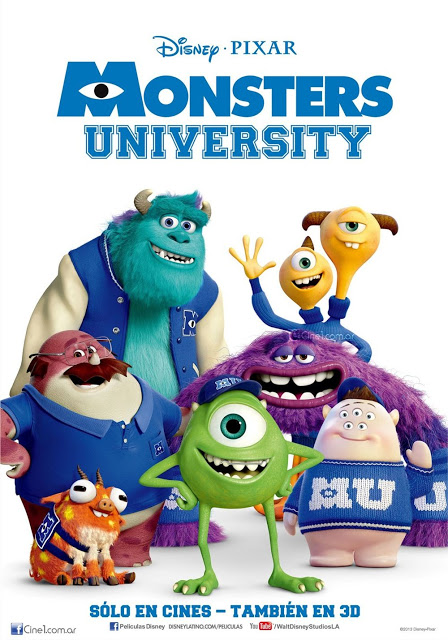
Finally, let's talk about Monsters University.  What a great film.  It's easy to come to expect greatness from Pixar, but with news that Finding Nemo is getting a sequel (a movie that is a lesser candidate for a sequel I can't imagine) it seemed as if Pixar had mined its creativity to exhaustion.  This proved that fear absolutely unfounded.  Sequels are hard, prequels harder (ahem . . . George).  Monsters University handled that challenge with aplomb and heart.  In fact, I was never really a fan of the first Monsters Inc., but this one seemed all the better.  And with Nathan Fillion as a voice actor, what's not to love?

Remarkably, the movie ended on a note that I hadn't expected.  In fact, as the credits started to roll the three year-old boy behind me turned to him mother and asked "why?"  She offered him a great explanation which I'll try to keep spoiler free.  Basically, "Because that's how it happens sometimes."  And she was right, and I left the movie feeling as though Pixar really had something to say; as much as they had an interest in entertaining three and thirty year-olds, they wanted us to reflect on how life actually is.  And they succeeded. 

Of all the movies I saw this weekend, Monsters University was the only one I recommend you see.  It was simply fantastic. 

Wednesday, July 24, 2013

Ring of Fire . . . Or, Pacific Rim Review

So, caveat emptor.  Pacific Rim, Guillermo del Toro's newest and most commercial foray into the summer blockbuster is big, loud, dumb, and fun.  It was everything (literally) I expected, and not much else.  Suspend your disbelief walking in, otherwise it's just going to be irritating.  But once you realize that you're not really there to see something that makes logical sense, it's much more entertaining.  And since your brain has already been partially deactivated, it makes it that much easier to overlook the many plot holes, the abominable acting, the inept plotting, and utter lack of character.

This is a movie about big robots and bigger monsters.  It's a movie about destruction wholesale and not an ounce of emotion, pathos or humor.  Sure, there's some slap-stick, but it's so tied to overworn stereotypes and racial prejudice that it's simply banal.

But it's monsters.  And robots.  But while I enjoyed the fights -- which truly felt visceral -- I was never engaged in the characters, nor did I truly ever feel a sense of danger.  No one I cared about was ever truly in danger; cities, after years of assault by massive kaiju (Japanese for "really big monster") had gotten good at evacuating with little warning -- as a result, human populations were miraculously spared.  And our heroes (such as they are) were so two-dimensional -- no.  Strike that.  It wasn't that they simply lacked depth.  There was no there there.  They were dots on the screen that lacked arc, growth, or any conceivable motivation.  The only character with a hint of story was so maudlin that at times I wondered if she was just really good CG.

But the CG was amazing.  I never felt anything other than belief in the existence of these giant, incomprehensibly walking, fighting robots.  So normally I'd advise against seeing this type of movie, but the spectacle is so extraordinary that it has to be seen in the theater, if it has to be seen at all.  If you like the genre, I'm sure you'll enjoy this celluloidal romp.  If you don't like the genre, you'll probably still enjoy the wanton carnage.  It is the perfect amalgamation of Independence Day and Real Steel, that only demands you watch without a shred of intelligence or reflection.

While this movie has sometimes been advertised as science fiction, and del Toro announced that he wanted to make it a kind of Gothic sci-fi, it is neither Gothic nor science-fiction.  The technological mind-meld that del Toro asserts gives the movie its moral conflict is boring and utterly underutilized as a moral conflict.  Characters jump in and out of one another's minds with such ease that I wondered why it was even a big deal or even part of the story.  In fact, it's so easy to do that a human being can "drift" with a kaiju, demoting this particular McGuffin to irrelevancy.  But the whole movie is a McGuffin -- something which is explained with so much hand-waving that it devolves into farce, or the worst kind of fantasy.  Technology and science are so poorly understood that even a middle-schooler should be offended.  It was the worst kind of pandering.  (My favorite line [After a new Kaiju emerges bearing its own EMP and the functioning robots have been fried because of their digital systems our hero says of his robot]: "It's nuclear.  Analog."  Though, it's not quite as bad as this gem: "Let's do this!  Together!")

This is a moment, I suppose, to reflect on the dumbing down of our entertainment.  There's no reason this movie couldn't have had monsters, robots, plot and a decent character arc with a mediocre plot.  It would have required a director committed to making something other than schlock.  It would have required a half-way decent writer.  It would have required producers and a studio willing to take a risk.  But if The Lone Ranger and John Carter taught us anything, it's that studios are pretty willing to take risks.  So why don't they take the right risks?  Why don't they invest in something that isn't malto-meal for my eyes?

Just a few thoughts.

Bottom line, while I was entertained, it was cheap, mindless entertainment that I can't in good conscious recommend.  But hey, that's what summer movies are for, right? 

For comparison, here's a fan-girl review from Mary Sue that makes me wonder if we were watching the same movie.

Wednesday, July 17, 2013

This is the End?

Several times while watching "This is the End," Seth Rogen and Evan Goldberg's attempt at biting social commentary, I caught myself wondering, when will this end?  Never rising above crass physical comedy, pervasive drug and sexual humor, and mediocre satire, this movie seemed to never end.  Ostensibly about six friends trapped together during the Apocalypse (wearily confused with the Biblical rapture, in which Christians are taken bodily to Heaven), it is really a disjointed treatise on friendship, self-sacrifice, and what constitutes the "good life."

I literally suffered for this movie, riding my bicycle 22 miles to see it, and though that shouldn't affect my appreciation of the movie, it did.  While I wouldn't say that my money was stolen (I used a gift card, after all) I suspect that my time was wasted.  I was never really entertained, and listening to six actors self-referentially dissect their faults on screen, parodying or satirizing their own misbehavior, seemed boorish, at best.  At worst, it was simply tedious.  At 107 minutes long, it felt both rushed and never-ending.  The two minutes discursive about how one should or should not dispose of one's ejaculate ("I'll come wherever I want, Franco") was particularly distasteful.

But, you know, maybe this just isn't my scene.  As one character complains after being dragged to James Franco's house party, he would just rather be at home hanging out with his friend.  I can sympathize.  The competing visions of happiness at odds here are a kind of philosophical treatise.  On the one hand, the hedonism of James Franco house party (a wannabe starlet doing lines of coke off Michael Cera's ass was particularly telling) contrasted with the slacker existentialism of Jay Baruchel, who would rather get high and play video games while reconnecting with his estranged friend, Seth Rogen.

Interrupting this philosophical competition is the rapture, which snatches "those of good heart" into heaven, while leaving the rest (including our gang) trying to figure out what happened.  Added to the mix are demons and hell-spawn intent on eating, raping, and tormenting the remainder of humanity.  The movie is far from subtle, and its maladroit handling of human depravity, what it means to be good, or even the basic theological implications (as one character says, "This means there's a god.  I haven't been living as though there was") left me wondering what other people have been raving about.

Generally, the reviews have been positive.  Many people see in the film a calm reflection on the L.A. lifestyle, the superficiality of Hollywood, and a generally comment on the hollowness of modern life.  I don't see that at all.  I can see where the writers wanted to make those comments, but it was like watching someone pick gnats with boxing gloves on.  In general it was just embarrassing.

More distressing was the blatant mishandling of Biblical material -- far from the most egregious mishandlings of the Bible that I've ever seen, but painful nonetheless.  Willfully misrepresenting the opposition's argument isn't simply lazy, it's deceitful, and blatant plagiarism.  But juxtaposing this mishandling was a disturbing depiction of heaven that remains misogynistic and sexist.  Finally overcoming their selfishness through various acts of self-sacrifice, our heroes are bodily taken to heaven, where they are told whatever they can imagine will come about.

While this worked in "What Dream May Come," it fails here.  Insofar as our selfish characters have learned a token humility, they are incapable of imagining anything but petty pleasures.  Weed is of course obtainable in Heaven -- though one wonders why one would need to be high in Heaven.  But on top of that, women appear as bikini-clad sexpots, representations of their sexuality, and I had to wonder why the producers feel heaven is as sexually exploitative as their Hollywood existence.

This led me to suppose this is their idea of heaven.  By dressing heaven up as a white-linen-clad and somewhat foggy realm populated by the same vapid  characters as occupy their moral cesspool the producers have consciously chosen to reject a life of moral, philosophic, or intellectual perfection and substituted instead a sexually dominant paradigm that casually rejects individual liberties for more than half of humanity.  Even the message that one should reject selfish ambitions in order to achieve perfection is simply a parody meant to highlight the real message: that selfishness is in fact a worthy end in itself.

I found this movie abhorrent and would recommend it to no one.


Monday, July 8, 2013

Man of Steel Review

Lest this blog become too devoted to movie and book reviews, I'll endeavor in the coming weeks to get more up-to-date content up.  That means TV reviews, in case you're wondering.  And I might even pause to pen a few anecdotes and observations.  Now that I'm a college graduate, I feel I've earned the right to opine profusely for a few short weeks.  Then I'll have to dive back into the real world of nine-to-five.

But until then, let's talk about Man of Steel.  Starring Henry Cavill as the rarely-named Supes (I'm told there was a bit of a snafu involving the rights to the Superman name, but haven't confirmed that for myself) and Amy Adams as the precocious Louis Lane, this movie managed to do something interesting with a character that has more often than not languished in obscure, ether-sucking abstraction.  I mean, let's not point fingers, but Lex Luthor's land-making, land-grab scheme in Superman Returns was just . . . banal.

Man of Steel mixes it up a bit, and in doing so manages to create the right balance between moral dilemma and abstract what-if.  Because, let's be honest about something.  Superman is a god among men -- a literal Ubermensch.  What does a god do when settled among mortals?  This paradox lies at the heart of the movie, and while it doesn't succeed gracefully, it does manage some success.  Where it makes missteps, I'm more than willing to accept and forgive them because of the larger story being told.  Nowhere do the missteps seem so overwhelming that I simply cannot overlook them (take a look down at Star Trek Into Darkness to see some mistakes that I will not forgive -- I mean, come on J.J. . . . gravity doesn't work that way at all.)
This is how gravity works.

The movie itself strikes a very fine line between origin story and dramaction.  Russell Crowe, despite his many appearances in the movie, is largely not present, but we're reminded often that the ghost of Jor El haunts Clark Kent, who is torn between his two identities: Human and Kryptonian.  The sacrifice of both fathers are played to maximum effect.  On Krypton, Jor El sacrifices himself to ensure the life of his son on a world where he would be as a god among us.  And Jonathan Kent, whose sacrifice ensures that Clark can continue to live an unremarkable life blending in with human beings.

Forgetting for a moment that Superman is an alien being --and the movie does not let us forget for an instant -- the tension between Lois and Clark is tantalizing, without ever being over the top; foregone, thankfully, is the glasses ruse used to such laughing effect in both the comics and earlier films.  Hardly a spoiler, but Lois knows that Clark Kent is Superman nearly halfway through the film, and conspires with Superman to conceal his identity from humanity at large, and from her editor, and various military types in general.
Juxtaposition, anyone?


This allows a much more organic progression to their relationship, without the entirely saccharine tension of will-she-find-out so prevalent in earlier incarnations -- and indeed still with us in Superman Returns.

That leads me to a moment of speculation.  And behold!  There be SPOILERS ahead.

At the end of the movie, Zod having been defeated by both human gumption and Man of Steel brawn, decides to remove his exoskeleton warsuit and go mano a mano with Supes.  The problem with this has been highlighted in Superman's own upbringing, and by an earlier scene when Superman destroys the Zod's helmet.  Something in the atmosphere affects Kryptonian physiology so that the full potential of their super powers are manifested.  Yeah, they're strong under just the yellow sun, but our atmosphere knocks it up a notch and gives the Kryptonians super senses as well as, conceivably, the ability to defy gravity.

Superman, as he points out to Zod, has had years to overcome the naturally vertiginous effects.  He can focus his senses and block out the remaining cacophony.  Zod, without that training, is overwhelmed the first time his helmet is removed.  But later, in the final showdown, he declares that as a genetically bred warrior, he has honed his body his entire life, and can master his powers in an afternoon.  Eschewing his warsuit, he demonstrates his mastery by beginning to fly, a skill which Superman has only just acquired (once he put on the suit).
Pretty sure he took the red pill.

This is where I have a beef.  I believe that Zod purposefully took off the suit knowing that Superman's thirty years of soaking up the sun would make Superman more powerful.  That though well-matched, Superman was nevertheless superior, and that in taking off the suit Zod committed himself to forcing Superman to kill him.  He'd already declared that with the Genesis Chamber on the scout ship destroyed, he had nothing.  He'd committed himself to destroying Jor El's son already, but knowing that he was likely to fail, Zod realized that his final bid was to force Kal El to take his life.

He accomplished this in the subway, where it came down to Superman's option to save the earthlings, or kill Zod, and Superman chose us.  His mantle wasn't placed on him, he'd willingly taken it up.  And the movie succeeds with this final showdown where so many others fail because this version of Superman is not some nihilistic god bound by obligation to defend humanity, but rather one that has willingly committed himself to our good.

And that's why I choose to overlook its several flaws -- because ultimately the story revolves around the choices that the characters make and ultimately their very real ramifications.   

Friday, May 24, 2013

Dark Night of the Soul . . . Or, Star Trek Into Darkness Review


A comment on the franchise?
Let's get something out of the way first.  I like Star Trek.  I was a fan of the reboot and the original series.  I'm a huge fan of Deep Space Nine and I think it represents a solid attempt to combine action with a meaningful debate on the morality of war, religion and about a million other things.  It was also fun as all get-out.

Which is what Star Trek Into Darkness definitely is.  Fun.  A wonton romp to just about nowhere, without rhyme or reason.  And several 'splosions.  And Alice Eve in her underwear.  Because, I mean, really.  For what other reason does her character appear except to randomly (and it really is out of the blue) undress in front of Captain Kirk?

Which is basically what this movie boiled down to.  A lot happened -- from a terrorist attack, to an interstellar manhunt, to a ten-second debate on the existential dilemma between law-and-order and justice -- but not a lot really happened.  Cribbing many of its lines from Star Trek: The Wrath of Khan, it felt like a bad joke, or a poorly timed parody of a film that was deeply invested in exploring the boundary between life and death, heroism and the extent of scientific advancement.  Moreover, "Wrath of Khan" has a deeply emotional conclusion which is the ultimate culmination of decades of on-screen relationships between the central characters.
Because why not?

Ultimately, the second Trek is a silly pastiche of Star Trek tropes that descends quickly into inanity.  While it moves quickly, the pacing seems directed at brushing over its shallowness; the humor is sophomoric and the petty bickering between Kirk and Spock is just that: petty.  While it might be a spectacle to behold, it left me with a bad taste in my mouth.  It was pandering of the worst kind.

I don't recommend this movie to really anyone.   

Tuesday, April 30, 2013

Django Unchained . . . Or, American Violence We Need

Between going to the beach and doing homework, this weekend I saw "Django Unchained," Quentin Tarantino's obsequy to spaghetti westerns, and an odd critique of American slavery.  I say odd because though the movie is a revenge thriller of the usual variety, Tarantino phrases it within the mythos of the American south.  That is, while one would normally expect to see a lone gunman wandering the west in search of redemption, Django is a gunman in search of his wife in the American south, particularly Mississippi.  Discovering she has been sold to a plantation owner who specializes in the buying and selling of fighting slaves (think dog-fights but with black men).  Since it is a revenge flick, everything you'd expect to happen, happens.

But it takes an odd course to get there.  From the trailers, it is obvious that Django allies himself with Christopher Waltz as a bounty hunter.  The buddy-cop theme is played to perfection, without the slapstick we'd normally expect.  Instead, we're offered a discrete rumination on the horror of slavery, the perverse peculiarity of this American institution, and the ridiculous contradictions inherent in the system. 

Despite all that, I thought it was a good movie.  A bit on the bloody side, with the Tarantino-esque ridiculousness of the whole thing, but it felt visceral and thrilling and downright amoral.  Slavery was the obvious bad guy, with various minor bad guys along the way.  The moral lever was tilted toward Django the entire time and despite killing men in cold blood, we were meant to assuage our collective guilt with the assurance that they were slave traders and guilty enough to deserve death. 

Nevertheless, I thought it was a good movie, and I would quickly recommend it.

Friday, March 22, 2013

What Sunshine Got Wrong And So So Right . . . Or, Why I Like Boring Sci-Fi

I like boring sci-fi.  I like the science fiction where not a lot happens.  I like exploring derelict space ships, the limits of human understanding, and the void between our aspirations and our accomplishments.  In short, I'm okay if a gun never goes off, nothing ever blows up, and no one dies in my science fiction. 

That means that I really enjoy movies like 2001 and 2010 (although there is violence of a kind, it definitely drives the plot), Star Trek: The Motion Picture, Contact, Moon, and Sunshine.  The highlight, of course, is Contact, Robert Zemeckis's adaptation of Carl Sagan's book of the same name.  It's a beautiful soliloquy on faith, belief, and love.  It also doesn't have a lot of action.  Sure, the first time/space machine gets blown up by fundamentalists, but even that was understated and served to advance the plot.

Sunshine, Danny Boyle's film about humanity imperiled by a dying sun, is predicated on an explosion.  When I think about it, I tend to group it with other 'splosion-will-save-us-all movies like Armageddon, Deep Impact and The Core.  Ostensibly, they're all sort of science fiction.  At least, if you took the science-y bits out, it wouldn't work.  Two of them have space ships; the world is imperiled in all of them; and some sort of techno-babble is needed to save the world (which at this point is about all we can expect from our science fiction--woe to our science illiterate public).  In the end though, the world is saved when the asteroid is exploded, or when a series of nukes are able to restart the spin of the Earth's core, jumpstarting its stalled magnetic field.

I have a feeling these were all funded in part by nuclear apologists, or written by people who saw nuclear weapons as more than just humanity-killers.  These movies, in my mind, all have the subtitle: "Or How I Learned to Stop Worrying and Love the Bomb."

In that respect, Sunshine isn't much different.  In the movie, the sun is dying.  We're not really told why, but if you listen to the director's commentary, you get a really nifty, scientific explanation.  Basically, a chunk of dark matter fell in and disrupted nuclear fusion.  The only way to save the sun is to dislodge that chunk so fusion can resume.  Here's where the Bomb comes in.

In order to save themselves, humanity mined half of all the fissile material on the planet, shoved it on a ship and shot it into the sun, and planned to detonate it to knock that chunk of sun-killer back into interstellar space.

Of course it failed.

Fortunately, humanity had just enough fissile material left over for one more go.  And this is where our story picks up.  The Icarus II (you know, because no one reads anything other than Greek mythology) is heading to the sun to deliver its cargo when it picks up the distress signal from the Icarus I.  They have a choice: stay on mission, or divert to see what happened, and maybe salvage the boom-juice from the first mission in case their's isn't enough.

In this movie, either option would have satisfied me.  Watching the ship recede behind them, listening to the distress signal, wondering, letting their curiosity drive them mad, would have made for an intriguing movie.  Perhaps they would have received some sort of indication that someone was still alive on the ship; oh, the complications that would have inspired. 

Instead, the decision is made to go ahead and see what happened and as you can imagine, things go badly.  Some miscalculated by a fraction of a percent, but this close to the sun, that means a lot.  And people die.  And the ship is nearly debilitated.  And they don't find out what happened on the Icarus I.  That miscalculation--that decision--not only meant they nearly lost their lives, but also imperiled the continued existence of humanity.  Heady stuff.

And the movie at this point could have continued to make deep insights, tell compelling story, and build on the stresses of fallible human beings engaged in a last ditched effort to save everything.  Instead, (and trying to keep it pretty spoiler-free) someone starts killing people.  The crew has to hunt down the bad guy (whoever he might be) and continue the mission, which suddenly seems all the more imperiled.  

The movie is visually beautiful, the sound work is stunning, and the acting understated and believable.  So it's a tragedy that it had to take such a sudden and dramatic turn in the second act.  What began as good science fiction devolved rather quickly into pure action for no reason than that it would probably sell tickets. 

The premise is great; the science is great; the decisions are real and believable and delightful.  So while the movie isn't perfect, it still ranks in my top 10 favorite science fiction movies.  Give it a shot.
 

Monday, January 14, 2013

Zero Dark Thirty Review

By Steven McLain

Spoiler alert: bin Laden dies at the end.  But we all knew that going into the theater.  The really intriguing part of the movie isn't the outcome, but how it was achieved.  Like most things in life, the journey is just as important as the destination.  Especially when that journey comprises the biggest manhunt in human history, and is fraught with moral conundrums and political machinations beyond the movie theater.  The reason for all the fist wrangling is that the film-makers had extraordinary access to CIA agents and information about the manhunt for bin Laden and because the movie depicts aspects of "heightened interrogation techniques" beyond what was officially acknowledged.  Simply put, Zero Dark Thirty, directed by Kathryn Bigelow and starring Jessica Chastain, takes a hard look at the methods used to gather intelligence not only about the location of Osama bin Laden, but also forthcoming attacks such as the London and Madrid bombings.  In this respect, the filmmakers make a hard decision about how to portray coercive interrogations--torture. 

As a moral argument, few people would quibble over whether to use torture as a means to extract timely information that might prevent an attack, or save someone's life.  The old story goes something like this: a child has been kidnapped and the kidnapper has been caught, but the child has not been found and the kidnapper refuses to disclose the child's location.  Are law enforcement officers justified in using torture to extract that information and save the child's life? 

Lawmakers and intelligence agencies in the war against terror have contended that torture is a valuable and justifiable method for gathering intelligence that might prevent attacks against American interests.  But is torture justifiable in gathering information about the location of Osama bin Laden?  You could argue (and the movie does in passing) that by catching bin Laden further attacks could be prevented, especially attacks on American soil.  But politicians, and the American public, did quibble over the morality and legality of using torture to gather intelligence that would lead to his capture.  By that point, the war in Iraq had eclipsed the war in Afghanistan, and the hunt for bin Laden had been pushed the back burner.

Jessica Chastain as CIA agent Maya
The movie follows that back-burner effort, spearheaded by Maya's quixotic efforts to find Osama bin Laden.  Except that we know those efforts were far from in vain.  In fact, he was caught, he was killed, and it may have earned President Obama a second term in office.  It galvanized support for the president, and offered a viable excuse for withdrawing troops from Afghanistan.  It was a literal nail in the war on terror's coffin. 

Zero Dark Thirty unflinchingly follows efforts to find bin Laden, and looks at the human cost (both to those being brutalized and the brutalizers) of so-called "enhanced interrogation techniques" and also at the way intelligence activities shifted toward electronic intelligence with the softening support of detainee programs on the homefront.  But the movie offers a look that is neither easy to classify, nor easy dismiss.  The character of Maya, whom the movie follows for much of the action (save the actual raid on the bin Laden compound, itself unsettling in its banality), is acknowledged from the beginning as "a killer."  She does not shirk from using torture, but the cost is plain on her face and we are left with a parting shot of her weeping--but are her tears catharsis or realization that her life is now meaningless, the majority of it devoted to finding and killing Osama bin Laden?

SEALs about to breach the bin Laden compound
Kathryn Bigelow manages to create a movie that is at once decisive and cloying, tempting the audience with answers but never fully revealing them.  Because, ultimately, the movie hopes to accurately represent reality, in which morality is never black and white, and answers are difficult to procure, if you can even stop to ask the right questions.  Are we, in those tears, meant to see ourselves?  Does Maya embody the American obsession with bin Laden?  And now that we took him out, the meaninglessness of our lives?  How do we confront the horrors of that obsession, and the cost we're still reaping in the Middle East?  These aren't easy questions to answer, but the movie declared brilliantly that they are questions we ought seriously to ponder.

Overall, I would recommend this movie to just about everybody.

Tuesday, December 25, 2012

In Space No One Can Hear You Groan . . . Or, A Prometheus Re-Watch

By Steven McLain

I originally saw Prometheus in theaters opening weekend.  I probably wasn't fanatical enough to see it at midnight, but I definitely saw it the next day.  When the credits began to roll, I looked over at my friend and asked, "What the hell?"  Because, at first brush, Prometheus seemed to be a steaming pile of poo.

But I couldn't imagine that the creative genius that had given me the original Alien franchise (which I enjoy in all of its incarnations, including Alien Vs. Predator) could make such a blatant promise to expand the Alien universe, and so horrendously fail at delivering an interesting, engaging movie.  I didn't want to believe the hype about it not being an Alien prequel, and I felt pretty smug when the first alien popped out of the black goo and immediately sucked itself to a witless scientist's face.  That seemed pretty blatantly out of Alien.  Imagine my surprise, then, when characters began behaving inexplicably, plots went nowhere, an albino colossus arrived, and suddenly not-Ripley was being chased by aliens.  I felt cheated.

So, I had to wonder if maybe I'd expected too much from this movie.  Maybe I brought too many preconceptions and simply failed to let the movie speak to me on its own merit.  With that in mind, I rented it from a local RedBox, and now I'm going to give it go.  Fresh, as it were.  Let's see how it stands up to a second viewing.

Press play.  Let's get this party started.

***Major SPOILERS ahead***

Oh, a planet.  What planet is it?  Could it be Earth?  Is it the past, present, or future?  Who knows?  (It's gorgeous regardless, like something the BBC would produce.)  And a giant shadow sweeps from overhead, obscuring the sun--quick cut to a lone mendicant figure approaching a waterfall.  He's strangely buff, and pure white.  What kind of crazy technology does he have?  Wait, he's drinking it.  And while the spaceship ascends into heaven, he dissolves and we dive deep into his body at the cellular level to see his own DNA breaking apart.  As he tumbles into the primordial waters, cue "Prometheus" and a montage of new cells replicating.

Super flash cut to some time later (millions--billions?--of years) to an archeological dig where some sort of scientists find cave markings (dating 35,000 years ago) and we've suddenly told that "they" want us to come find them.  And another quick cut to the spaceship Prometheus, heading to an undisclosed destination, and David the Android making the rounds, checking up on the ship, being super-athletic, super-smart, watching old movies to imitate human behavior and generally being the most interesting thing we've seen so far.

Once they've arrived at their undisclosed destination, and everyone is awakened (and Meredith Vickers proves she's a bad-ass by doing pushups while still dripping from the cryo-sleep) they receive a debrief from Peter Weylan (who manages to make his artificial son both immeasurably happy and immeasurably distraught in the same sentence by reminding him he has no soul) and tells the crew they're looking for the creators of humanity.  The archaeologists (why are they in space?) tell everyone that ancient civilizations, millennia and continents apart all describe giants reaching toward a particular "galactic configuration" so far away that no one from Earth could possibly have known about it.  And they "choose to believe" that its a map toward the "Engineers."  After paying over a trillion dollars to get them there, Vickers reveals that the scientists (archaeologists, biologists, just what the heck do they study?) can't actually make contact (if the aliens even happen to be there).

Now, for no particular reason, they land the ship on the planet.  The CG is gorgeous.  Once more, Scott has demonstrated his acumen with special effects.

After discovering an alien structure, everyone gung-hoes it on over (after a quick quip about how inhuman David is, underscoring the not-very-subtle theme of Creation/Creator) and proceed to immediately knock on the front door.  The first thing they do is map the structure with automated mapping drones.  And the guy whose job is to map the structure, who comments that the drones are his "pups" is the very first guy to get lost!  But before that happens, off they go meandering into the depths of the structure and discover there's a breathable atmosphere within the structure (with hints that the aliens have been terraforming the planet).  Then, just to prove how bad-ass everyone is (or trusting, or stupid) everyone takes off their helmets.

By exploring the ancient alien ruins, the movie clearly embeds itself in hard-core science fiction.  Discovery is the name of the game in any sci-fi; the sense they we are all tiny parts of a greater, universal whole drives science fiction, and the first forty minutes or so of the movie are clearly sci-fi.  These, then, are the tropes the audience will come to expect, and the questions that must be resolved by the climax.

Back to the movie.  After David inexplicably touches a couple buttons, the hallway plays back a recording of three or four aliens sprinting down the hallway, and we see the violent death of the fourth when he is decapitated by a closing door; its dead body (2000 years dead) is lying in the dust.  And now the geologists (who is in charge of mapping the structure, and has a nifty mapping app on the smart-doodad on his wrist) goes wandering off back to the ship.  Once more, David pushes buttons without any particular rationale, and opens the door; and we discover both the head of the dead alien and what appears to be an egg room, filled with the same egg sacks we saw in Alien.  Not an Alien prequel, my butt. 

And then Not-Ripley makes the first (and possibly only) sensible statement of the movie: "Don't touch it."  Don't touch the strange alien technology, please.  With a storm on the way, the scientists head on back to the ship (but not the first two, who have instead gotten lost).  On that note, when the scientists rush back in the face of the storm, they note that "they have already taken off" seeming to refer to the two scientists who left earlier, but who are in actuality lost in the structure.  Where the heck did the transport go?  Silly director can't keep track of all his superfluous characters.

After a minor mishap, everyone gets back to the ship, except for the two scientists who are lost inside the alien structure.  Since I've already addressed how ridiculous this is, I'll move on.

Oh look, they brought the alien head back to the ship and now they're doing experiments on it.  Except it's not a head, it's a helmet and there's a head inside!  It's one of the white guys we saw at the beginning.  And it's perfectly mummified.  So perfectly mummified that they can see new cellular growth on the skull.  And using some sort of psuedoscientific technobabble, they manage "trick the nervous system" (which has been dead 2000 years) into believing its alive.  And then it explodes.  There's green goo everywhere.

After the first intimations that Peter Weylan is alive and on the ship, Vickers assaults David to find out what he told David.  "Try harder," is the nebulous answer.  But then David goes and extracts samples from the alien device he found in the egg-room.  At the same time, Not-Ripley gene sequences the sample from the exploded head (isn't she an archaeologist?) and discovers that it's the same as human DNA.  And David ominously states that "big things have small beginnings" once he extracts some of the black goo from the device.  Most ominously of all, he then slips Dr. Holloway (male scientist) some black goo in his drink.

The two engage in a tete-a-tete about the nature of creation and the theme of Creator/Creation is expanded so that David expounds on the disappointment he feels about his own creators, and the disappointment that we would feel realizing the Engineers are our own.

Back to the structure, where the lost scientists discover a pile of dead aliens, ruptured from the inside.  And a mapping probe discovers a life-form and the lost scientists are tasked to go see what it is.  But then it mysteriously disappears and the two scientists head in the opposite direction.

Back on the ship, Dr. Holloway whines about how he wanted to chat with the aliens, but now he can't.  "Life isn't special" we're told, anyone with some DNA and a dash of brains can make it, and Not-Ripley reveals that she is infertile and the two have hot make-up sex.  And then, for no good reason that I can discern, ice-queen Vickers gets some jungle-fever and heads down to the bridge to seduce the captain.  Actually, she headed down there so that the screenwriter could get empty the bridge so that no one could witness the travesty about to transpire in the alien structure.

Said travesty being the two scientists, one who has modified his suit into a gigantic bong (giving excuse for their idiocy), poking the cobra-like alien that suddenly appears.  As Steve Irwin knew, you shouldn't poke things that don't like being poked.  Then, inevitably, the alien manages to invade one suit and implant an egg deep inside his chest.  (And of course, since this is not an Alien prequel, I have no idea what's going to happen next.)

The next morning, after male-scientist discovers something dark and wormy in his eye and dismissing it, the lost scientists are discovered incommunicado and everyone goes off looking for them.  David, meanwhile, goes off on a secret mission to figure out what that mysterious glitch (and the intermittent life-form signal) was from the night before.  Oh look, a room full of those strange black-goo canisters.  And the alien command center.  David, of course, must explore.  And the dead scientist and the implanted scientist are both discovered, and Holloway's sickness is revealed.

David, meanwhile, has managed to restart the command center and is once more shown a playback of the crew's last moments, which includes a map of the known universe and the planets that have been seeded with Engineer DNA.  Grand, sweeping music plays to remind us that we are still in a science-fiction movie (not the action/horror into which it is quickly devolving).  Then David discovers the Engineer in stasis.  So maybe Holloway and Weylan can meet their maker after all.

On the way back to the ship, Holloway begins to change.  They realize it's not a simple illness, but rather an alien infection, and Vickers is determined to impose quarantine (with a flame-thrower, no less).  To protect the woman he loves, Holloway submits himself to the flames.

Fears of contagion spread; Not-Ripley undergoes a bio-scan and discovers that she is pregnant (but how can that be, since she's infertile?  Oh that's right, she's incubating alien spawn.)  David gets steadily creepier by this point and dopes Not-Ripley so that they can put her in cryo-sleep to take her home, but she's wise to the plan and fights her way to med-pod and uses the auto-surgery function to cut the bastard out of belly.  (Assuming some pretty hefty antibiotics, you still have to wonder how she can go superwoman later in the movie with a foot-wide gash stapled closed in her abdomen.)

Once the alien is removed, stoned-scientist returns to the ship.  Or does he?  Nope.  It's his body possessed by the black goo and while Not-Ripley is stumbling around, bleeding and weak from her surgery, he goes on a fiery rampage in the cargo bay.  Nothing but the captain (and his flame-thrower) can stop him.  Not-Ripley (pretty high on morphine, I've gotta admit) stumbles into Weylan's pod where people we've never seen before are tending to his recently thawed self.  He gets to meet his maker and jaunts off to see the albino colossus.  With all the recent carnage, however, Not-Ripley tells him that the Engineers aren't what the scientists (seriously, what did they get their doctorate in?) thought they were.  Weylan taunts her by wondering if she's lost her faith.

Back in Not-Ripley's cabin, the captain posits that they've stumbled over an Engineer weapons depot; they made weapons of mass destruction and they turned on the Engineers.  Not-Ripley and the captain wax eloquent about preventing the spread of contamination, then Not-Ripley follows Weylan into the alien structure to see just what the heck it's all about. On Prometheus, the captain discovers that there's an alien ship inside the structure.

In the alien structure, David reveals that the Engineer ship is heading to earth to destroy everything living there.  Then he wakes up the sleeping Engineer, who is not pleased to see David, Weylan or anybody else.  And suddenly we're running form baddies.  Not really sure why.  Perhaps it's a comment on the inherent hostility of the universe, or its ultimate unknowability, or simply the Lovecraftian notion that we're not all that important in the grand scheme of things.

Regardless, now that he's been awakened, the Engineer launches the ship toward Earth, sealing himself in the space-jockey suit that has nothing, whatsoever, to do with the original Alien.  And the rest of the movie is running, trying not to be fried to a crisp when the alien ship launches, outrunning a tumbling alien space-craft, fighting off an alien whose metabolism defies thermodynamics, and ultimately defeating the Engineer.  In the process of which, the alien impregnate its Engineer creator and the xenomorph is created.  Because, you know, this isn't a prequel to Alien.

So, other than the fact that this isn't a prequel to Alien, I actually enjoyed this movie a lot more on the re-watch.  I'm still uncertain about a lot of the plot holes, and genuinely unsure why any of it happened, much less how human beings were created 35,000 years ago by alien Engineers who then (roughly around the time of Christ) want to destroy humanity.  That being said, it holds up better than I initially thought, and generally feels like a good science fiction.  But the initial premise, the early questions, are left unanswered (even though David tells us "the answer is irrelevant"), and ultimately, the promise that the movie made in the first sequence is unfulfilled.