Jimmy "Wild Bill" Stark fought his way out of Hell and now he's back to wreak vengeance on the men and women who put him there. That's the nutshell synopsis of Sandman Slim by Richard Kadrey, a wild thrill-ride of supernatural mayhem that takes the tropes of urban supernatural fantasy and turns them on their heads. After being banished to hell by the men and women of his coven, James Stark fights for eleven years in the arena of Hell against supernatural creatures, manipulated by demonic generals and even Lucifer himself. But when the opportunity presents itself, Stark seizes it and makes good his escape from Hell.
Priority number one, find and kill the men and women that sentenced him to Hell. First, though, he has to find them, and this comprises the bulk of the novel. Interspersed throughout are hints of a larger supernatural world, filled with werewolves, vampires, zombies, and a branch of Homeland Security collaborating with angels. It's quick, irreverent and a lot of fun.
This isn't a particularly unique addition to the urban fantasy subgenre. Nothing about the content stands out as unusual except for the voice of the protagonist. Told in the first person present tense, this novel manages to evoke a noir sensibility within the confines of urban fantasy. That alone makes it worth reading. The voice comes across as gritty, weary and terribly angry, yet maintains the pace and wit of a good graphic novel. Snappy one-liners abound, and we follow the protagonist through his anger, grief and confusion.
Despite these drawbacks, they are minor and Kadrey presents the beginnings of a rich and evocative world full of supernatural wonders. The hints of greater goings-on and the beginning of deeply emotional connections abound and I expect the subsequent books in the series to exploit all the hints that's he's laid. It's fun, and definitely worth reading. I definitely recommend it.
Showing posts with label Book Review. Show all posts
Thursday, December 20, 2012
Wednesday, November 21, 2012
Me, Myself and H.P. Lovecraft . . . Or, The Eldrtich World of Lovecraft Tributes
H.P. Lovecraft might be the most influential American author of the twentieth century that you've never heard of. Chances are you know people he's influenced, from Stephen King to Mike Mignola. But chances are equally great that if pressed, you might not really know Lovecraft from either of those two. Lovecraft is a strange case of fame come too late. In this case, his fame is almost entirely posthumous and due in large part to the efforts of friends after his early death to preserve his writing.
The most obvious reason you've never heard of Lovecraft--or if you have heard of him, never read him--is the dense, archaic prose in which he embeds his horrifying tales of the strange and eldritch. Indeed, that prose is difficult for the uninitiated to fathom, and the threshold accordingly high. Yet those who do plumb the depths of Lovecraft come away better for it; or at the very least, with a new perspective of humanity's role in the universe.
Because Lovecraft is the first author of the twentieth century. What I mean by that is the H.P. Lovecraft was the first author to fully understand the anomie of the twentieth century as science removed humanity from its lofty position in the heavens. The culture dissonance that would occur after the First and Second World Wars was preluded by H.P. Lovecraft. His fiction divorces human beings of universal importance; to Lovecraft the universe is cold, and inhabited by beings so vast and powerful that their actions cannot even be described as malicious or aggressive. They simply are, and to confront them is to beard madness.
For all of these reasons (and probably more) Lovecraft has made something of a comeback in the last few decades. He's always enjoyed cult status, but the fall of the Soviet Union made him much more salient. The rise of international terrorism and the absurd turn we've made in light of 9/11 makes him all the more relevant. The mortgage crisis of 2008. The Occupy Movement. All are Lovecraftian. Because he's all about forces beyond our understanding, and he knows that to confront them is to fall victim to madness.
Writers have paid tribute to Lovecraft for decades, but much of the earlier work focused on expanding the mythos Lovecraft had created. August Derleth, who did the most to rescue Lovecraft from obscurity, also traded on the name and expanded the world that Lovecraft created, embedding his own moral and theological beliefs into a universe that Lovecraft understood to be largely amoral.
Recently, I have had the pleasure to read two different takes on Lovecraft, and the idea of an uncaring, hostile universe. The first was given to me as a gift, and features Lovecraft in historical settings. Historical Lovecraft, published by Innsmouth Free Press, features 26 tales divided into roughly three historical epochs: Ancient history, the Middle Ages, and Modern Times. Very much in the vein of stories initiated by Derleth, each story varies in how closely it hews to Lovecraft. Some are deeply disturbing, and remind us that the universe is cold and dark; others feel like modern horror. While you could make the argument that the modern zombie fascination is very Lovecraftian, the menace and the malevolence are simply lacking. Nevertheless, disentangling Lovecraft from the early twentieth century New England in which he wrote allows us to see the broader implications of his mythos.
The second collection of short stories is a collection of Lovecraftian science fiction. The transition from Lovecraftian horror to science fiction is an easy one to make. Alien seems so much like it came from Lovecraft's own imagination that one has to wonder if HR Giger and the writers (Dan O'Bannon and Ronald Shusett) weren't channeling his spirit. Initially considered a horror movie, Alien has come to be regarded as seminal in a new style of science fiction in the universe is--you guessed it--cold and amoral; daring to look it in the eye may reduce to you a gibbering mass.
Space Eldritch, published as an ebook (with a print version on the way) by Cold Fusion Media, takes a somewhat different approach. Narrower in scope than Historical Lovecraft, the stories themselves are more intimate and less disturbing. Science fiction owes a debt of gratitude to Lovecraft, and it shows in the writing of these pieces. Often paying tribute to pulp sensibilities as much as to Lovecraft, except for a few touchstone Lovecraftian images, few of the pieces seem to disentangle themselves from the science fiction tropes we've become familiar with. Both Mission to Mars (the godawful travesty featuring Gary Sinise and Tim Robbins) and Paul Verhoeven's Total Recall make appearances when we encounter something menacing lurking beneath the Martian soil (to be fair, however, Philip K. Dick's influence is just as ubiquitous in science fiction as Lovecraft is in horror.)
Ultimately, this collection of stories simply lacks the menace of Lovecraft. Maybe that's a product of our times. We've become used to the idea that science has all the answers. Or at the very least, that answers exist. Lovecraft was less interested in that than in examining a universe beyond human ken. And I think the authors of Space Eldritch have failed that test. They're fully a part of the modern zeitgeist. Maybe we can't go back, but I like to think that Lovecraft is still viable and an important perspective in these uncertain times.
The most obvious reason you've never heard of Lovecraft--or if you have heard of him, never read him--is the dense, archaic prose in which he embeds his horrifying tales of the strange and eldritch. Indeed, that prose is difficult for the uninitiated to fathom, and the threshold accordingly high. Yet those who do plumb the depths of Lovecraft come away better for it; or at the very least, with a new perspective of humanity's role in the universe.
Because Lovecraft is the first author of the twentieth century. What I mean by that is the H.P. Lovecraft was the first author to fully understand the anomie of the twentieth century as science removed humanity from its lofty position in the heavens. The culture dissonance that would occur after the First and Second World Wars was preluded by H.P. Lovecraft. His fiction divorces human beings of universal importance; to Lovecraft the universe is cold, and inhabited by beings so vast and powerful that their actions cannot even be described as malicious or aggressive. They simply are, and to confront them is to beard madness.
For all of these reasons (and probably more) Lovecraft has made something of a comeback in the last few decades. He's always enjoyed cult status, but the fall of the Soviet Union made him much more salient. The rise of international terrorism and the absurd turn we've made in light of 9/11 makes him all the more relevant. The mortgage crisis of 2008. The Occupy Movement. All are Lovecraftian. Because he's all about forces beyond our understanding, and he knows that to confront them is to fall victim to madness.
Writers have paid tribute to Lovecraft for decades, but much of the earlier work focused on expanding the mythos Lovecraft had created. August Derleth, who did the most to rescue Lovecraft from obscurity, also traded on the name and expanded the world that Lovecraft created, embedding his own moral and theological beliefs into a universe that Lovecraft understood to be largely amoral.
Recently, I have had the pleasure to read two different takes on Lovecraft, and the idea of an uncaring, hostile universe. The first was given to me as a gift, and features Lovecraft in historical settings. Historical Lovecraft, published by Innsmouth Free Press, features 26 tales divided into roughly three historical epochs: Ancient history, the Middle Ages, and Modern Times. Very much in the vein of stories initiated by Derleth, each story varies in how closely it hews to Lovecraft. Some are deeply disturbing, and remind us that the universe is cold and dark; others feel like modern horror. While you could make the argument that the modern zombie fascination is very Lovecraftian, the menace and the malevolence are simply lacking. Nevertheless, disentangling Lovecraft from the early twentieth century New England in which he wrote allows us to see the broader implications of his mythos.
Space Eldritch, published as an ebook (with a print version on the way) by Cold Fusion Media, takes a somewhat different approach. Narrower in scope than Historical Lovecraft, the stories themselves are more intimate and less disturbing. Science fiction owes a debt of gratitude to Lovecraft, and it shows in the writing of these pieces. Often paying tribute to pulp sensibilities as much as to Lovecraft, except for a few touchstone Lovecraftian images, few of the pieces seem to disentangle themselves from the science fiction tropes we've become familiar with. Both Mission to Mars (the godawful travesty featuring Gary Sinise and Tim Robbins) and Paul Verhoeven's Total Recall make appearances when we encounter something menacing lurking beneath the Martian soil (to be fair, however, Philip K. Dick's influence is just as ubiquitous in science fiction as Lovecraft is in horror.)
Ultimately, this collection of stories simply lacks the menace of Lovecraft. Maybe that's a product of our times. We've become used to the idea that science has all the answers. Or at the very least, that answers exist. Lovecraft was less interested in that than in examining a universe beyond human ken. And I think the authors of Space Eldritch have failed that test. They're fully a part of the modern zeitgeist. Maybe we can't go back, but I like to think that Lovecraft is still viable and an important perspective in these uncertain times.
Tuesday, November 20, 2012
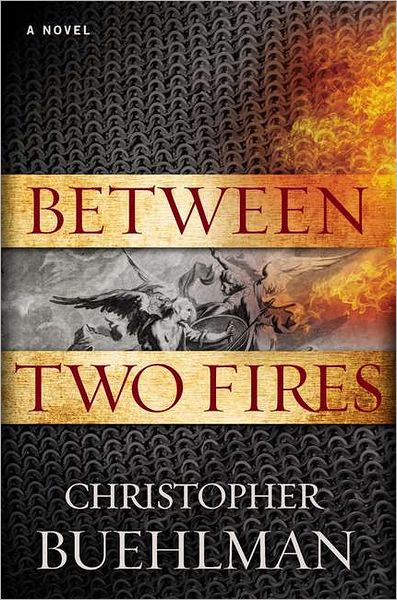
Between Two Fires Review
By Steven McLain
War, once more, has erupted in Heaven. Not content with their place in Hell, the fallen angels have once more made war against Heaven. But in their struggle, they have not yet been able to pierce the walls of Heaven and instead have turned their eyes on the Creation of the Lord. Caught between Heaven and Hell, the sons of Adam, and daughters of Eve, are left undefended as the angels struggle to defend their realm. Because in Christopher Buehlman's sophomore novel Between Two Fires, the Lord does not avail Himself to defend either His realm, or His creation.
In an attempt to usurp the Lord's place, the fallen have turned their attention to the earth, and have seemingly unleashed the Four Horsemen of the Apocalypse: Death, Famine, Pestilence and War. But Buehlman does something unique with this oft-turned trope: Instead of setting his novel in the present and drawing analogy to wars and rumors of them, Between Two Fires is set in the fourteenth century France. During the height of the Hundred Years War, he dares suggest that the horrors of Crécy and the pestilence of the Plague that nearly destroyed Europe in 1348 were the work of nefarious agents, as many suspected, and in fact believed.
The story follows a knight errant, a waif, and a priest whose entire village has been emptied by the plague. Buehlman doesn't suffer modern sensibilities. The coarseness of the fourteenth century abounds. Feudal, paternalistic, harsh, we're treated to an intimate portrait of a world we should be glad has left us behind. Beginning with the near rape of our fourteen year-old hero, Delphine, we're immediately greeted to the sight of a village decimated by bubonic plague. Defending Delphine from the depredations of his wandering brigands, our knight Thomas grudgingly takes her under his wing, or she takes him under hers, as she can see angels.
This is not the first time we've heard of French girls heeding the advice of angels and saints. Joan of Arc would lead her people to victory against the English a few years later and galvanize French nationalism. But against charges of heresy, Joan fared worse than Delphine, who in Buehlman's novel, has been inspired to correct much of what the fallen have undone. That journey, part Canterbury Tales and a great deal of Barbara Tuchman's A Distant Mirror (to which he pays homage in the acknowledgements), leads through Paris, many smaller towns and villages, and eventually ends in Avignon. Along the way, Thomas battles aberrations, demons and monstrosities of various sorts, both mortal and immortal. We see the inhumanity of antisemitism, the prejudice and superstition of an age before Enlightenment, and the horrors of a world in which government is as often predator as it is protector of the people.
Unfortunately, the novel disintegrates roughly three-fourths through, as Delphine and Thomas arrive at the gates of Avignon. The threat posed by the demons is clarified, but the menace is lacking. Somehow, imagining demons as the ultimate source of our own worst excesses seems shallow, and though we'd expect deus ex machina in a story that features angels, demons, and the Lord as characters, somehow the climax lacks the divine grandeur one would expect. The denouement, however, is poignant, and underscores the redemptive theology of Catholicism at that time, the same theological thread which would wind through many facets of Protestantism in later centuries.
Ultimately, Between Two Fires is a book that demands a reasonable knowledge of Medieval history, and particularly the vagaries of the Hundred Years War. For instance, one must know that schism in the Church had induced the Pope to relocate to Avignon; that Crécy was the first instance of the domination of the English longbow on French battlefields, and not the storied fields of Agincourt; and, especially, the sometimes strange feudal relationship between villein and seigneur. These details definitely reveal much of what Buehlman cannot take the time to say, and I wonder how someone without that knowledge would read this book.
While I would definitely recommend this book, I would not recommend it universally. Those with an interest in the Middle Ages, or have some background knowledge, will find it thoroughly enjoyable. I cannot speak to the pleasure others will garner. So, mixed recommendation.
War, once more, has erupted in Heaven. Not content with their place in Hell, the fallen angels have once more made war against Heaven. But in their struggle, they have not yet been able to pierce the walls of Heaven and instead have turned their eyes on the Creation of the Lord. Caught between Heaven and Hell, the sons of Adam, and daughters of Eve, are left undefended as the angels struggle to defend their realm. Because in Christopher Buehlman's sophomore novel Between Two Fires, the Lord does not avail Himself to defend either His realm, or His creation.
![]() |
| Battle of Crécy |
The story follows a knight errant, a waif, and a priest whose entire village has been emptied by the plague. Buehlman doesn't suffer modern sensibilities. The coarseness of the fourteenth century abounds. Feudal, paternalistic, harsh, we're treated to an intimate portrait of a world we should be glad has left us behind. Beginning with the near rape of our fourteen year-old hero, Delphine, we're immediately greeted to the sight of a village decimated by bubonic plague. Defending Delphine from the depredations of his wandering brigands, our knight Thomas grudgingly takes her under his wing, or she takes him under hers, as she can see angels.
![]() |
| Joan of Arc, 1485 |
![]() |
| Palais des Papes, Avignon |
Ultimately, Between Two Fires is a book that demands a reasonable knowledge of Medieval history, and particularly the vagaries of the Hundred Years War. For instance, one must know that schism in the Church had induced the Pope to relocate to Avignon; that Crécy was the first instance of the domination of the English longbow on French battlefields, and not the storied fields of Agincourt; and, especially, the sometimes strange feudal relationship between villein and seigneur. These details definitely reveal much of what Buehlman cannot take the time to say, and I wonder how someone without that knowledge would read this book.
While I would definitely recommend this book, I would not recommend it universally. Those with an interest in the Middle Ages, or have some background knowledge, will find it thoroughly enjoyable. I cannot speak to the pleasure others will garner. So, mixed recommendation.
Friday, October 12, 2012
Osama Review . . . Donnie Darko meets L.A. Confidential
Osama, by Lavie Tidhar, is the story of Joe, a surname-less detective hired by a mysterious woman to track down Mike Longshott, author of Osama: Vigilante. Written in a kind of post-noir Chandler-esque chic, it quickly becomes apparent that Joe inhabits a world markedly different from our own, where certain notable events either never happened, or went off on an oblique. Tidhar's sense of place is impeccable, from the rain-swept streets of Vientiane to the wilds of London (on both sides of the surreal), to Kabul, where Tidhar evokes ten or more years of bombings compressed into a single instant--the absurdity of this moment, and others, drawn out by snippets throughout the book.
Absurdity seems to be what this book is about; the absurdly disproportionate response by a superpower against terrorists a world away, the absurdity of a war against terror, the absurdity of men destroying themselves as a last gasp at communicating their own creed. Mike Longshott is the absurd moniker taken by an Afghan man who glimpses the world beyond the veil, our own world, and attempts to comprehend it absurdity by capturing it in fiction.
On the surface, this is the story of one man's search for Mike Longshott, but classifying this subtle and haunting book as alternative history or science fiction is to miss the point. Tidhar manages to blur the real and the unreal in such a way that truth and fiction combine in such a way that we're unable to distinguish one from the other. And maybe that's the point. Because by the end we're left with a man who's seen beyond the veil of the real into a world of gross surveillance, paranoia, and killing for the sake of terror. Ultimately, Osama is a haunting soliloquy about this strange new world none of us could have foreseen and hardly any of us understands.
I would recommend this book to a friend.
Absurdity seems to be what this book is about; the absurdly disproportionate response by a superpower against terrorists a world away, the absurdity of a war against terror, the absurdity of men destroying themselves as a last gasp at communicating their own creed. Mike Longshott is the absurd moniker taken by an Afghan man who glimpses the world beyond the veil, our own world, and attempts to comprehend it absurdity by capturing it in fiction.
On the surface, this is the story of one man's search for Mike Longshott, but classifying this subtle and haunting book as alternative history or science fiction is to miss the point. Tidhar manages to blur the real and the unreal in such a way that truth and fiction combine in such a way that we're unable to distinguish one from the other. And maybe that's the point. Because by the end we're left with a man who's seen beyond the veil of the real into a world of gross surveillance, paranoia, and killing for the sake of terror. Ultimately, Osama is a haunting soliloquy about this strange new world none of us could have foreseen and hardly any of us understands.
I would recommend this book to a friend.
Friday, September 21, 2012
Alif the Unseen Review
| Salon.com |
Anonymity is a resounding theme throughout the novel. People are rarely referred to by their names--Alif, as I've already stated, is not his real name, and though we're offered hints about his true identity, he remains essentially nameless. Characters throughout the book are disguised by their aliases, as an erstwhile Saudi prince is referred to as often as not by his own hacker tag. A young American woman studying in the city is known only as "the convert," and the slew of magical beings (including one pretty nifty jinni) are compromised by the fact that few people even believe in their existence. A young woman in a niqab exists only as glimpses of skin and kohl-lined eyes.
With this pervasive theme resounding through the book, I expected a subtle reflection on state security, the need for privacy in a democracy, and indeed, the book touches on each. Clearly, a book about a hacker who provides secrecy-services is going to involve those layers of secrecy undone, and Wilson obliges. When Alif comes into possession of a book reputed to have been written by jinn, he is suddenly the object of the man in charge of hunting down all those people Alif has been hired to protect. With the very real threat of the State looming behind the hunt, Alif knows that to be captured is to risk torture and death. Yet the book seems to indeed possess a kind of magic. Not magic in the fantasy sense, but magic in the coding sense, since it offers insights into building the most powerful computers on the planet.
Wilson's technical naivety shines through here. Though she manages to get some of the technobabble correct, it lacks of the feel of a truly knowledgeable writer--something that Neal Stephenson and William Gibson have been perfecting over the last two decades. But I forgave her the shallowness of her technical prowess--this is, after all, a fantasy (or very nearly). With the hint of jinni in the wings, and set in Arabia, it seems far too easy to populate this world with a sideways world of jinn, effrit and other magical creatures out of The Arabian Nights. This might have been handled poorly, but by acknowledging her sources, Wilson allows the reader to maintain the sense of disbelief necessary to plod through the abusively ponderous second act into the third.
Which is about where the story falls apart. What began as something subtle and nuanced becomes a diatribe about modern belief--about the lack of belief inherent in modern society. Constantly preaching, Wilson's aforementioned "convert" seems to be a poorly veiled (sorry about the pun) version of herself, experiencing the inconsistencies of all modern religions, and the necessary faith one requires to follow them. This feels both sudden and inconsistent with the tone and pacing of the book prior, and hardly matches the themes she so carefully crafted at the outset. Indeed, one is forced to wonder if she experienced a crisis of faith while writing this books, as I experienced while reading it.
Real life rarely intrudes, or at least informs, books. Certainly, the events of the real world might alter the way in which I perceive a particular book, but as I was reading Alif, extremists in Libya set fire to the American embassy in Benghazi and killed the American ambassador. Meanwhile, protests had been sparked in Egypt over a controversial film depicting Mohammed as a philanderer and a pedophile. Subsequent protests have since been staged throughout the world, including Australia.
The anger I felt at the death of our ambassador no doubt colored my perception of this book. And I can't help read into it the way in which the Arab Spring has metamorphosed into a wild grasping for power, as all revolutions must eventually go. I doubt my sense of disappointment with the novel would have been alleviated if the assassination has not occurred, yet I can't help wonder if some of my own residual anger tempered this review. I like to think that I am more impartial than that, but I have to admit that it may have. So, take this with a bit of salt; overall, I thought the book was flawed, with great potential that Wilson was unable to exploit.
I would not recommend this book to a friend.
Wednesday, August 15, 2012
Another Hugo Update . . . Miéville For The Win!
Who's Gonna Win the Hugo? This Guy . . .
It says it on the cover: "A fully achieved work of art." These are Ursula K. Le Guin's words, and I have a hard time thinking of someone better qualified to make that sort of pronouncement. Moreover, China Miéville reads a bit like Le Guin at her best. I don't mean to compare the two, but that same sense that the author is doing something truly original not only with the story but with the bounds of language itself.
Because Embassytown is a story about language. About what it means to relate meaning through simulacra, these noises that we emit and, arbitrarily and through common use, agree actually have meaning. Much of the story revolves around Avice, a human woman who has become a simile in the language of the Arikenes, the indigenes of strange alien world where the village of Embassytown has been constructed. In this alien tongue, only two things are immediately apparent--they cannot lie and they cannot understand us.
In order to facilitate communication, the Arikene (or Hosts, as the story calls them) enact elaborate rituals to create new ideas. Avice, the protagonist, is a particularly useful simile. Notorious for being the only member of this society to have ever left and returned to the godforsaken hinterland, she bears the fame of her similification uneasily, especially when she realizes that she has created a paradox within the Host society that may very well tear it apart.
Finally, human beings have reached a partial solution to the communication breakdown. The solution, however, requires human cloning, techno-pyschic pair-bonding, and psychological training to allow two individuals to think--and then speak--with the same mind. These pair-bonded individuals provide the vital link between the human colonists of this world and the alien indigenes, whose cooperation and largess they require to make any sort of life there.
Then something unexpected happens, and the very fabric of their society is torn apart.
If that last sentence sounds a bit melodramatic, that's because it is; but it's hard to express the sudden turn that Miéville weaves into the narrative without divulging much of what makes the book so unique. Because the sudden and terrifying arrival to their society is not all that terrifying. The world itself changes so that you can divide the book easily into before and after. This is the type of dramatic turn that is both unexpected and deeply satisfying, because it is both internally consistent with the fictional world that he has created, and subtle enough that you probably didn't see it coming--yet nonetheless had to have been.
Embassytown isn't as abstruse as some of Miéville's earlier works, especially Perdido Street Station and The Scar. Some of the flair and gusto is gone, leaving a stripped-down story comprised of pure characterization and plot, and the bare essentials of world-building. Don't get me wrong, what's there is pure Miéville and is all the more delightful for the economy with which he parses the world to the reader.
In the end though, Embassytown is a gentle meditation on language, both its limits and its potentially infinite variety; as such, it transcends genre expectations and revels in the delight of fine storytelling.
Sunday, August 12, 2012
Hugo Update . . . And What's In An Award?
Right now, I'm about halfway through this year's Hugo nominees. Among Others, and Leviathan Wakes are pretty good. Since I still have yet to read more than the first hundred pages of Games of Thrones, I'm not really qualified to comment on A Dance with Dragons. That really just leaves Embassytown with the third installment of Mira Grant's Deadline series.
First of all, the Hugos are not like a Pulitzer or Nobel Prize. The first recognizes great American works of literature, and the second rewards an author's life work--the Noble Prize, in other words, rewards the entire oeuvre.
When I was a kid, and played little league, we'd end the season with a pizza party and golden trophies. Everybody got one and it symbolized your participation much more than your particular contribution. Now, I'm not saying that the legitimate efforts of highly talents people shouldn't be rewarded
The Hugo Award was set up to reflect popular trends in genre fiction. As such, it reflects what people like, as opposed to what is good. Now, don't get me wrong, many of the Hugo awards have been granted to exceptional works of fantasy or science-fiction. But what makes good genre fiction is not necessarily what makes good literature. At the heart of it, good literature challenges both the reader and the author. First the author must transcend the limitations of the medium to explore the bounds of human nature. The reader, on the other hand, must equally endure.
Michael Cunningham, one of the triad of jury members picking this year's Pulitzer Prize in fiction, explains at the New Yorker some of what went into choosing three titles from more than 300. What was so remarkable about his article, however, was not the behind-the-scenes work of jury members, but really he philosophy of what a particular award signifies.
He says that "[fiction] involves trace elements of magic; it works for reasons we can explain and also for reasons we can’t. If novels or short-story collections could be weighed strictly in terms of their components (fully developed characters, check; original voice, check; solidly crafted structure, check; serious theme, check) they might satisfy, but they would fail to enchant. A great work of fiction involves a certain frisson that occurs when its various components cohere and then ignite. The cause of the fire should, to some extent, elude the experts sent to investigate."
What this tells me, however, is that the utterly ineffable parts that Cunningham and his co-jurors suspected of greatness did not ignite a fire in the souls of the board members. So I'm curious how other awards will fare.
Will, for instance, A Dance With Dragons beat out China Mieville and Jo Walton? Each of these books has brilliance lurking between their lines, but G.R.R. Martin is the old favorite, and his series has recently received a boost in popularity with the made-for-premium-cable television series based on his books. Certainly, a spike like this can't be bad for Martin, but is it necessarily good for the Hugos?
Extending this line of thinking a little, Leviathan Wakes is the first book in an expected trilogy. Should we even consider something admittedly unfinished?
Perhaps it doesn't matter, though. Maybe this is an opportunity for the community to express its collective happiness with a particular author or work. Maybe its a moment for sci-fi and fantasy geeks to acknowledge their favorites and just celebrate with one another their own, personal pleasure at being part of the process. Because ultimately, awards are as much for the audience as they are for the recipient. That little trophy (be it a golden man, a rocket, or a golden bucket of popcorn) symbolizes that we enjoyed something. And we want you to know it.
So maybe the Pulitzer board already has life figured out and they don't need the challenge a good work of fiction symbolizes. Or maybe they're so far removed from the American experience that they no longer recognize it when it's staring up at them from the pages of very fine works. Either way, we'll still smile, and clap and cheer ourselves on and reward the fiction that we love.
Wednesday, August 1, 2012
Arctic Rising by Tobias Buckell
Just finished Arctic Rising by Tobias Buckell. Gotta say it. Pretty good book. I was a little worried for the first half or so; it seemed like a run-of-the-mill chase/mystery. Mostly the mystery of why our protagonist is being chased. But then he pulled it out of the fire and I realized that he was doing something really interesting with both the story and the characters.
In writing classes, you hear about the stereotype of the protagonist a lot. What that means is that, in general, you imagine the hero of the story to be a lot like you. I think Buckell blew up every stereotype I have with Anika, the star of the story. Female, Nigerian, lesbian . . . you name it. Yet Buckell never let those things overwhelm the character; she was her own voice within the story. And don't get me started with the Russian druglord (sounds like a cliche, doesn't it? But it ISN'T!), the Caribbean spy (who would've thunk it?) and the strippers-with-guns. Suffice it to say, his characters are rarely cardboard cutouts.
And the story. Whew. The STORY! I have never really rooted for the end of the world the way I have in this book, and Buckell makes that okay, because this is eco sci-fi, a new niche in the genre popularized by Paolo Bacigalupi (of Windup Girl fame). The world is a different place; the ice caps have melted (yep, they're gone) and most of Canada has opened for exploitation. This has made a lot of the smaller, northern countries a lot wealthier and a lot more powerful. Where wealth and power combine, there is some serious interest in keeping the status as quo as it can be. So what happens when someone wants to put the world back the way it was? That's what you're going to find out in Arctic Rising, and I think (no, I'm pretty sure) you're going to love finding out.
Subscribe to:
Comments (Atom)