Wednesday, May 6, 2015

Spacing Out . . . Or, Two Spaces or One?


The good ole days

It’s a debate as old as the internet: One space after the period, or two?  I was surprised to learn that this is a difficult question to answer.  Half the people I’ve spoken with add two spaces after a full stop.  The other half raise an incredulous eyebrow and tell me that one space is not only preferable, but get morally indignant that I even asked.  I kid a bit, but in all seriousness, if you were to ask Plato which is better, he might tell you that a single space correlates most closely with the Ideal manuscript formatting.

So what’s the deal?  Turns out the biggest part of it has to do with when you learned to type.  If you learned to type on a typewriter (or shortly after word processors were introduced) you probably add two spaces after the full stop to accommodate the monospacing font on the typewriter.  More simply, when the striker on a typewriter impacts the paper, the letter takes up the exact same amount of space as any other.  So the I you type occupies the same space as an M.  That’s not the case when you type on a word processor, whose fonts are variable (and may or may not have serifs).

If we extend that to the present, most documents are not only produced on word processors, but are also published online.  The digital revolution produced a surprisingly homogenous landscape, with writers forced to learn new rules.  But, in the early days of internet publication, no one had yet figured out just how to format their writing.  You can still sometimes see this, if you type something on Word and then post it straight to a blog site—the pagination is strange and sentences are broken up at odd places.  This led to a revision in publishing expectations: now writers were expected to accommodate the internet by only inserting a single space after a period.
The not-so-good ole days

Turns out, this is all just another one of those generational divides with everyone over thirty on one side (and who trusts us anyway?) and those meddling kids (I would have gotten away with it too, if it weren’t for them!) on the other.

But I don’t like a single space at the end of a sentence.  It feels constricting.  A sentence ought to be more than an expression of fact, it ought to reflect certain aesthetic choices.  In a sense, how you write ought to communicate as much about your understanding of beauty and the way the world operates as it does about the simply communicating information.  This, of course, is a stylistic choice.

Style is tough to communicate.  As tough to communicate as to teach.  Strunk and White tried it, and Stephen Pinker chastised his colleagues in the sciences over their (lack of) style.  The basics of any style can be printed in a book and remonstrated against in lecture halls.  Omit needless or useless words; avoid cliches like the plague; death to hyperbole!  You get my drift.  Harder to instill a style that is completely your own.  Your style reflects your voice.  Maybe it’s conversational, perhaps it’s academic; it could be cold or warm or informal or meandering.  It should never be cookie-cutter. 
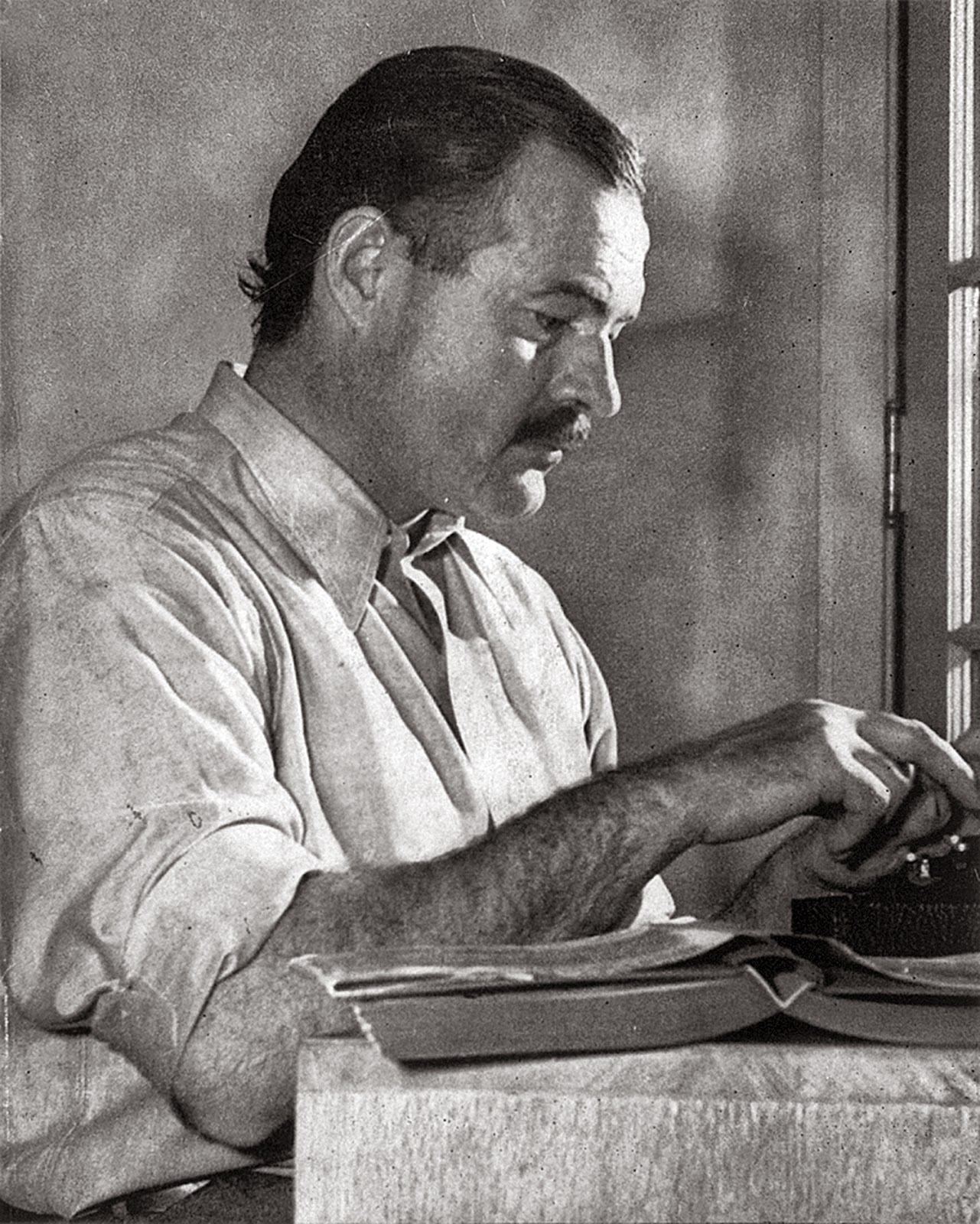
Hemingway on a typewriter
That last bit is the hardest to deal with, though, since it demands constant attention to craft and on-going refinement.  Hemingway and Faulkner are both known for the way in which they wrote their stories, as much as the plot or characters themselves.  But they had to listen to criticism, take advice, ponder, reflect, edit, rework.  In the end, their style is as much  a part of the narrative as the plot is.

Which brings me back around to tapping out space-space when I come around to the end of a sentence.  I like the space it gives me (pun, of course, intended).  There’s a little bit of additional room to  breath, a blank space into which I can insert my thoughts and reflections on what I’d just read.  It indicates to the reader that she should savor what I’ve offered. 

We live in a cramped world where experiences flash at us at 60 miles per hour.  Faster, sometimes.  If I only wanted to communicate facts, I would have written them as bullet-points.  I don’t.  I want you to experience my words as a reflection of who I am, to engage in a conversation with me. 

The dialogue that we construct together is tenuous, at best, but it is part of the long, strange process of becoming a person capable of introspection.  Ultimately, it’s about you and me sitting down together to share our thoughts. 

I’ve changed as much writing as you have reading (I hope) and those two little spaces at the end of the sentence have facilitated, in their own humble way, that process. 

So type on, I say.  Type on.

Thursday, April 2, 2015

The Scales of Justice Tilt for Thee . . . Or, the Right Right for the Left


I have a really hard time understanding conservatives. And not in a “how could they possibly believe that” sort of way. I mean that I have a hard time generally just following their line of thought. It must have something to do with the venue: National Review and other partisan outlets, such as FOX News, are mostly writing to themselves. They service an increasingly restricted demographic—their audience is shrinking—and as a result they can assume that their audience already knows the game. I like to imagine it’s a bit like people who are really into curling. To them it’s grand strategy; to me, it’s just some guys huddling around a rock on the ice.

The problem, as I see it, is that while they’re talking to themselves, they’re not talking to anybody else. Their ideas get lost in self-referential jargon and inside jokes. To insiders, it makes those ideas more accessible and helps foster an environment of exclusion: like culture broadly speaking, it helps distinguish “us” from “them.” But it quickly starts sounding as though you’re preaching to the converted; without external references, ideas get trapped in a feedback loop. Fundamentally what this means is that those inside the loop lose perspective.

It’s the same with liberals, of course. The Right has no monopoly on self-referential ideology. But as the United States moves farther to the left, it has embraced a form of liberalism that advances a notion of just behind what John Rawls referred to as the veil of ignorance—that we should all be treated equally before the law. Behind that veil, people are treated as individuals absent race, gender, sexual orientation, income, or what have you.

To conservatives, this perspective is patently absurd. Justice, in their sense, is a function of divine order: the world is naturally arranged so that certain people assume authority, be they kings, priests, generals, or fathers. To be virtuous, one had to rely on strict adherence to those hierarchies. A son had a duty to a father, whose duty was also to the church and state. Liberalism inverts that order, placing the duty on the state to the individual, famously in the idea of a blindfolded goddess balancing the scales of justice. The point is that she doesn’t know who is on either side: a gay man, a black teen, or the state.

Of course, as citizens we do have obligations to the state and to society generally. Conservatives are not wrong in that sense. Our democracy only works when each citizen is engaged in the body politic through voting (at the very least), expressing their opinions to elected representatives, and observing duties to their fellow citizen, among so many other obligations. The reason that Rousseau thought democracies could only work in small countries was because people were geographically close enough to talk to one another. So while chatting isn’t exactly a panacea, it would certainly go a long ways toward alleviating many of the difficulties liberals and conservatives are having getting their point across.

When you say it like that, of course, it sounds silly. Even trite. But it requires the moral courage to assume that your interlocutor is capable of kindness and charity, and then the far more difficult task of extending those virtues yourself.

Wednesday, April 9, 2014

The Watchers Watch with Increasing Watchfulness . . . Or, Why Google Glass Offends Me

Not so long ago, a guy came into my work wearing Google Glass.  (Or, as the convention should go, glasses.)  I responded . . . poorly.

It's hard to think of yourself as a person who would become affronted by the mere existence of an otherwise not-that-consequential a thing.  In fact, it's weird thinking that I'd ever dislike Google Glass.  It seems like something that the sci-fi nerd in me would love.

I watched Star Trek: The Next Generation as a kid, and was really in awe of Geordi's visor.  I thought it would be cool to have access to all those parts of the electromagnetic spectrum that the human eye simply didn't evolve a need to see.

The idea of recording everything you saw had a kind of voyeuristic thrill to it as well.  The beauty of a sunset was something that should be captured instantly; recording everything made recalling everything a snap; I believed that this kind of access would fundamentally improve lives in a still-as-yet-undefined way.

But when Google Glass actually entered my life, I was incensed.  "Is that on?" I demanded.  The wearer, to my chagrin, answered me literally.  "Yes."  And I was off.  "You have no right, it's an affront, an invasion, blah blah blah."

The thing is, being on and recording are two different modes of operation for Google Glass.  Yeah, it was powered on and he could access information and the like, but it wasn't recording.  Apparently in a nod to Star Trek (I opine), you have to tell it turn on.  "Ok, Glass, record a video." 

So this poor fellow was not recording anything, as much as my tablet, or some random stranger's iPhone was not recording video, though it has that capability.

Glass, however, is a third eye that is forever looking out at the world, and the uncertainty of whether or not that eye was watching me left me uneasy.

This, I think, is a subject worth pondering.  If the eye remains unseen, do we care that it's watching?  Certainly, the revelations by Edward Snowden have revealed the unseen watcher watching with increasing watchfulness (say that five times fast).  As American's (and differently-nationed citizens) grapple with that realization, the way in which they mediate their own lives also changes.

That, I think, is what offended me so much about Google Glass.

For a moment, let's consider that we are all mediated selves.  That is, we understand our place in the world through our relationships with other people; we moderate our behavior to conform to social and cultural expectations.  Our actions are mediated by how others perceive them.

Yet, we are also mediated by how we present ourselves to the world.  Facebook and other social media allows us to edit ourselves -- to self-photoshop (metaphorically, but also literally) -- and though we can argue the fundamental philosophical implications, that mediation is under our control.

Google Glass eliminates that control.  We no longer mediate ourselves as much as we are caught on camera unmediated.

The worst part of talking heads and the political echo chamber of the cable news cycle is that they so often take things out of context, or fail to treat the subject with humility or compassion.  People misspeak.  They sometimes speak out of ignorance.  Or they have been purposefully misquoted.  In effect, they are mediated by others without their consent.  Google Glass highlights many more ways that can happen.

And frankly, I have the right to mediate myself however I choose.  I may want every action caught on camera -- the wit with the wisdom with all the flatulence in between.  But I may not.  I have the right to be treated with compassion and humility.  We all do.  Part of what erodes that compassion is the increasingly sophisticated surveillance with which we have to contend.

The watcher may watch with increasing watchfulness, but the effect of being watched is to lose part of our own souls.  That's why I don't like Google Glass.

Monday, November 4, 2013

The Power of Three . . . Or, NaNoWriMo!

It's November, and you know what that means! 

National Novel Writing Month, or NaNoWriMo is in full swing.  NaNoWriMo began somewhat innocuously in the late 90s or very early 2000s (if my memory hasn't failed me).  Back in the day, the whole point was just to write 50,000 words (or so I recall).  Nowadays, the point of this whole endeavor is to write an entire novel from start to finish in a month.

At the very least, it get you in your chair writing; best case scenario, you finish the month with something you can sell.  More likely, you'll have something tangible to get editing -- and that's nothing to sneeze at. 

I was working on something fairly pompous in 2001 and decided that I would just use NaNoWriMo to work further aggrandize that pomposity. 

Since then, I've participated in NaNoWriMo two more times.  Each time, I used it to work on something already in progress. Each of those works were long and complicated.  Also, something like 2/3 didn't reach the end.

So this year I decided I would sit down and write a book from start to finish.  It wasn't going to be bold, or complex, or difficult.  It would be a little plot heavy.  And it would be between 50,000 and 65,000 words.  Also, aside from a pretty intimate understanding of the three-act structure, I have no idea what the plot even is. 

So far, a C-130 has been shot down, terrorists are running around Oregon backwoods, and our hero has undertaken to protect a young woman who may hold the secret of humanity's destiny.  (Superficially, it reminds me of The Fifth Element.  A movie that came out right around the time I was introduced to NaNoWriMo.  Coincidence?)

I'm pretty sure there's going to be a shadowy government agency, kung-fu, a Shakespeare spouting hero, and possible space travel.  So, you know, the usual.

If you're participating, let me know how it's going in the comments.

Also, click HERE for a story about how NaNoWriMo actually started.


Monday, October 28, 2013

The Human Journey Is Just Beginning . . . Or, Watching Star Trek: The Motion Picture With My Girlfriend

For my birthday, my girlfriend got me the Blu-Ray collection of the first six Star Trek films.  And then, just to prove that she loves me, she watched the Motion Picture with me.  All the way through.  And only fell asleep once.

That's a pretty big deal.  The most she knows of Star Trek is that 'splosion-laden parody from J.J. Abrams.  See, back in the late 70s, science fiction wasn't exactly a big property.  2001: A Space Odyssey had come out in 1968.  Stanley Kubrick's masterpiece set both the mood and tone in science fiction for the next decade.  The story was intellectual and dense; the plot was nearly incomprehensible on the first screening (and second, third, and fourth), and matched outstanding acting and exquisite modeling with a breathtaking musical score.

Then Star Wars: A New Hope happened.  It fundamentally altered the viewing public's perception of what a movie could be, and how science fiction ought to be presented.  But Star Wars isn't really science fiction.  Sure, most of the story happens in space but for all it's vacuum bona fides, the technology and plot are purely fantastical.

Sure -- most of the time we lump science fiction and fantasy together (they even have a nifty moniker: SFF) but the two are fundamentally different genres that happen to share a common origin.  But while fantasy hints that the universe is inherently inexplicable, science fiction examines the ways in which the universe can be understood.  Where they overlap is their reliance on knowledge.

In fantasy, that knowledge is arcane and restricted through either initiation or fortune to a select few.  Science fiction revels in the fact that with a little hard work the universe can be understood by everyone.  And in the fiction of SF, the reader himself is the initiate.

Back to Star Trek: The Motion Picture.  After Star Wars shattered just about every record ever, executives at Paramount Studios needed something spacey.  They already had Star Trek, and were working on a new television series, called Phase II, and spurred by the dedicated activism of fans.

The Motion Picture is something really special, encapsulating Gene Roddenberry's truly novel future within the framework of a genuinely compelling science fiction story.  The plot is simple enough: a vast, incomprehensible alien entity of unimaginable power and destructive capability is on a straight shot to Earth.  The U.S.S. Enterprise is the only starship within interception range.  Admiral/Captain Kirk and his crew head out to investigate, and hopefully turn it back.

If the movie had been shot today, the ending would be pretty simple.  After investigating the heretofore inscrutable, indefatigable, and indestructible thing they would have discovered a vital weakness and exploited it.  The movie would have ended with a vast fireball and Kirk high-fiving Spock on the bridge.

Except this was made back when movies weren't just Hollywood execs standing around in a circle-jerk.

The Motion Picture ends with discovery.  The entire movie is an extended meditation on the meaning of life (highlighted by a five-minute overture that would have left audiences isolated in the womb-like darkness of a movie theater) so it is appropriate that the final epigram announces "The Human journey is just beginning." It ends with a moment of reflection on what it means to be human.

Phase II Enterprise
But this first film is more than simply good science fiction; it's the most realized vision of the future in any of the Star Trek films.  Gene Roddenberry's utopian vision is reflected best here by allowing audiences to really see the future.  We see civilians, contractors, a dynamic range of social and sexual mores, the reality of space travel, and the inherent dangers associated with any technology.

One of the truly visceral moments of peril is when a transporter malfunction scrambles two people in mid-transport.  Ostensibly, this is to give both Spock and McCoy a plausible excuse to rejoin the crew of the Enterprise, but it does double-duty and elaborates the dangers of simply existing while illuminating Kirk's character.  When we see the restrained grief, and the terse consolation of the transporter tech, we are reminded that with authority comes responsibility and know that these deaths will weigh on Kirk.  But as important, he'll push on and accomplish the mission. 

Watching this movie with my uninitiated girlfriend brought out something else.  At one point, she commented that she would like to be friends with Spock.  Besides being incredibly cute, it reminded me that these characters feel real.  I would never want to hang out with any of the characters in Abrams's Star Trek (except possibly Scotty, but that's just because I think we could go find Nick Frost and grab a pint). But in The Motion Picture, these people all feel incredibly real, and more importantly, their relationships feel like more than reflexive tropes satirizing archetypes. 

Which is just to say that while Abrams's films are entertaining -- with their running, running, 'splosions, angst, faux pseudoscience, 'splosions and more 'splosions -- they are neither fantastical nor science fictional.  They don't elaborate on friendship, duty, compassion, or the search for meaning.  And beating the bad guy literally means beating the bad guy.  They're shallow romps.

The Motion Picture offers -- in fact it practically invites -- a second viewing.  It's almost certain that it will reward the effort.  Its intellectual precursor 2001 suggests a second watching, but is less successful than The Motion Picture.  For these reasons and more you should give it a chance this weekend, sit down with a beer, and really dive into the best of all Star Trek films. 


Monday, October 21, 2013

Where Do Babies Come From? . . . Or, Sexism And Women In Fantasy

A lot of electrons have been spilled recently about the presence (or lack thereof) and roles of women in fantasy stories.  Both The Mary Sue and Tansy Roberts have weighed in on the supposed historical justification of sexism in the fantasy genre, and each author makes compelling arguments.  Basically, it goes that women throughout history have played vital roles and pursued all sorts of careers so it makes little sense to indulge historically inaccurate portrayals of women in fantasy stories.

Roberts's critique of The Mary Sue is spot on:
"History is not a long series of centuries in which men did all the interesting/important things and women stayed home and twiddled their thumbs in between pushing out babies, making soup and dying in childbirth.

History is actually a long series of centuries of men writing down what they thought was important and interesting, and FORGETTING TO WRITE ABOUT WOMEN. It’s also a long series of centuries of women’s work and women’s writing being actively denigrated by men. Writings were destroyed, contributions were downplayed, and women were actively oppressed against, absolutely."
Her point is absolutely right, but then she moves to identify the two main tropes in fantasy as military/warfare and politics.  Magic is identified as a strong third, and links these to male dominance in historical reporting.  Ignoring the role that women played in war and politics, however, is a willful ignorance on the part of ancient reporters, and continues to be so in the fantasy genre.
"When it comes to politics, I’m sorry, but there are no excuses. Sure, women have been excluded from the public political process for large swathes of history and culture (except, you know, when they weren’t—even the supreme patriarchy that was Rome didn’t have complete control over the provinces, where female politicians and civil servants sprung up like weeds) but public is only one piece of politics. The Mary Sue article refers substantially to Game of Thrones, and that’s a very good example, but again you can look to history—as soon as there is any form of dynastic element to your politics, then women are IMPORTANT. Even when the political careers are solely male, those men have wives and families who have a stake in the proceedings and the outcomes, they have risks to take and campaigns to wage every bit as much as the men. And if the women’s politics are happening in salons rather than assembly halls… maybe you should be peeking into those salons. I can guarantee political DYNAMITE is going on in there. With finger sandwiches and mint tea? Why not?"
Okay, that makes a bit of sense.  But here's where I digress.  Historically inspired stories, like the fantastically successful Game of Thrones mentioned above, replicate stereotypes and inadequately populate fantastical worlds with shallow or fulsome representations of human activity.

I don't really want to engage the staggering sexism in fantasy except to make a more general point: historically inspired fantasy is boring.  Don't get me wrong, history is chock full of great stories, and they're perfect jumping off points for a couple dozen novels.  But historically flavored novels that simply replace the Lancasters with the Lannisters and England for Westeros (but what if St. George really did kill a dragon?) is about as interesting as sitting in traffic.

I suspect that my distaste for George Martin's novels stems from its conscious departure from fantasy tropes; instead of dealing with heroes and magic, his world is ours, though dimly glimpsed.  Essentially, it's bad fantasy and boring history, yet readers mistake it for verisimilitude the way a man dying of thirst will mistake a mirage for an oasis in the desert.

So thinking about fantasy as somehow a historical representation misses the point entirely.  Literature in all its guises is about human behavior.  Science fiction and fantasy offer wonder, but they also allow us to examine our present and speculate about our future.  Political worries, cultural values, dominant hierarchies are all reflected in fantasy and reveal a glimpse of the zeitgeist.  That is their power.

Science fiction excels by extrapolating human achievements to their logical end.  Fantasy can do the same by extrapolating human activity in settings beyond the mundane.  J.R.R. Tolkien reproduced the Earthly milieu consciously.  Writers following in that vein from Robert Jordan to Terry Brooks continued that trend with greater or lesser success.  Where G.R.R. Martin succeeds is creating a world disengaged from the environment of evolutionary adaptation -- though by failing to follow his worldbuilding to a logical end it quickly reveals its shaky foundations.  Brandon Sanderson's Way of Kings successfully disengages from a historical model by creating whole-cloth both a world and its inhabitants.

Marie Antoinette
None of these authors engage the elephant in the fantastical room, however.  Why there are human beings more or less indistinguishable from the reader is never addressed.  Indeed, it remains such a persistent trope that it is rarely considered.  C.S. Friedman's Coldfire Trilogy successfully tackles the trope by wrapping it science fiction -- the human beings in her story are the descendants of human colonists on an alien world (where physics is kind of wonky -- a concession to the genre which corresponds well enough with what we know of science).

Regardless, instead of confronting sexism in the genre, commentators like Tansy Roberts should instead engage sexism in our own culture (and in our authors), and recast the mirror which reflects it.  And calling your empire