Monday, August 5, 2013

Michael Whelan Is My Hero

I've always enjoyed Michael Whelan's illustrations. 

Eventually, I realized that many of the books I enjoyed had covers by Whelan, and I started picking up books simply because he was on the cover.  In my mind, his covers are what signifies a good sci-fi/fantasy book. 

I was especially excited when I learned that he'd done the cover for Brandon Sanderson's first book in The Stormlight Archive, Way of Kings. 

Tor recently revealed the cover of Words of Radiance, the second book in the Stormlight Archive series.  In the article, Whelan discusses his process, inspiration, and the method of turning fantasy imagery into an illustration on a page.  It's a fascinating article by a master illustrator.

Friday, August 2, 2013

When Does the Music Stop? . . . Or, Game of Thrones Season Three

I'm finally caught up on Game of Thrones.  The HBO television adaptation, that is.  The books?  Not so much.  I just can't get through the first interminable pulp of the first book.  And I'm a little curious how it made it to NPR's top 100 fantasy/sci-fi list.  But that's for another post.  This one is all about Season Trés of the TV show. 

It's sort of like how I imagine that childhood game, musical chairs in hell.  The music just doesn't stop.  My girlfriend summed it up best.  We could have just skipped to the last four episodes and not missed anything.  Lots of walking.  Boobies for no good reason except to keep viewers distracted from the fact THAT NOTHING HAPPENS!  But I know that stuff has happened, two seasons worth of back-stabbing, machinations, war, incest, torture, castration and ice zombies have happened.  But I never had the sense that any of that needed to take place over thirty hours of screen time.  In fact much of it could have been dealt with in a few well-delivered lines of dialogue.  "Whatever happened to Theon Greyjoy?"  "Oh, I believe he's been captured and tortured by a rival house."  "Let's go get him!"  And so forth.

I'm not necessarily a "hater" of the series.  I love the idea, and I love that they've given so much attention to set design and costuming.  But like the book, it feels sprawling in a way that diminishes from all that effort.  Instead of presenting us with a compelling story told through taut narrative, we're drowned in detail and told to ignore the ponderous pace and lackluster plot.  And of course distracted with breasts.  Because apparently we're all too libidinous to want to watch a television series that didn't needlessly exploit women.  (You don't need to tell me it's historically accurate.  A: I know.  And B: This isn't history.)  All the time needlessly spend ogling naked women could have gone to story telling, character, plot.  Anything else, really.

But let me dismount my soapbox.  I'm going to file Game of Thrones in the same category as Twilight and 50 Shades of Grey.  I don't understand the appeal, but I appreciate that people seem to like it.  Let's just agree to disagree.


Thursday, August 1, 2013

Man Booker Longlist 2013


I'm a little bit late on the ball this year.  I haven't read any of the books nominated for the 2013 Man Booker Award but I've heard good things about several.  Harvest by Jim Crace and A Tale for the Time Being have been praised as near-genre, and certainly many of this year's nominees play around with the form, and the range is spectacularly diverse.  I'll try to work my way through them in the coming weeks and give you a break from ponderous movie reviews.  


Five Star Billionaire Tash Aw (Fourth Estate)
Unexploded Alison MacLeod ( Hamish Hamilton) 
TransAtlantic Colum McCann (Bloomsbury) 
- See more at: http://www.themanbookerprize.com/news/longlist-2013-announced#sthash.PAaamyCm.dpuf
Five Star Billionaire Tash Aw (Fourth Estate)
Unexploded Alison MacLeod ( Hamish Hamilton) 
TransAtlantic Colum McCann (Bloomsbury) 
- See more at: http://www.themanbookerprize.com/news/longlist-2013-announced#sthash.PAaamyCm.dpuf
Five Star Billionaire Tash Aw (Fourth Estate)
Unexploded Alison MacLeod ( Hamish Hamilton) 
TransAtlantic Colum McCann (Bloomsbury) 
- See more at: http://www.themanbookerprize.com/news/longlist-2013-announced#sthash.PAaamyCm.dpuf

Wednesday, July 31, 2013

What A Movie Weekend . . . Or, What Do The Wolverine, World War Z, Red 2, and Monsters University Have In Common?

This last weekend I binged on movies.  Matinee pricing is too good to pass up and I was stuck in town.  So I decided I'd check out some movies that were just opening, one that I wanted to see despite the objections of fan-boys and my own sense that the book was probably better, and one that earned its place on the strength of its predecessor. 

Let's start with World War Z.  We'll start there mostly because that's where I started.  First movie out of the gate.  Based on the cult-hit novel by Max Brooks (author of the Zombie Survival Handbook) which takes familiar zombie tropes and ponders what it would look like on a world-wide scale, told from multiple perspectives in documentary fashion.  Documentary in book form means something different from documentary in movie form.  In book form, it means "pertaining to documents."  It's usually just a compendium of documents which relate to the given topic.  On film it's a whole other beast and Michael Moore and Ken Burns tend to pop up a lot. 

The film version of World War Z is not documentary in any way.  It's an efficient, competent action film without anything to speak against it.  But it also doesn't have a lot going for it, either.  Brad Pitt does a fine job as some sort of UN gopher: hopping from hot spot to hot spot putting out fires.  We're never really told what he does, just that he's the best at it and it gives him an insider's look at mass panic.  The zombies are fast, which they were not in the book, but I don't think it matters.  We're given a glimpse of a world-spanning epidemic and the human response varies from garrison-states (literally) to nuclear bombs, to whole countries ripping out their teeth in a single day to prevent disease vectors. 

It was fun, but wasn't particularly compelling.  And if you really want the book, go read the book.  The movie is fine on its own.

Following that was The Wolverine.  It was okay.  Hero (and his abs) faces an existential crisis.  Has a call to adventure from a spunky Japanese girl with a sword called "The Separator" because it separates head from torso, or limb from torso or what have you.  She uses it to cut beer bottles in half.  Wolverine glances at it, decides his are better.  Anyway.  It's basically what you'd expect.  Some of the acting was spotty, but the movie as a whole was well plotted and well executed.  Of special note was the remarkable decision to look at the bombing of Hiroshima and Nagasaki from the perspective of the Japanese people themselves, though it was necessarily downplayed in the movie.  One of the better X-Men movies I've seen recently.

Red 2 sucked.  It had moments of mediocrity, but I felt like it wanted to be Mr. and Mrs. Smith and simply failed.  Bruce Willis was Bruce Willis, and John Malkovich was the only reason to watch this movie.  He's Martin Freeman thirty years older.  With only a single action piece that was genuinely fun to watch, this movie was as tired as the actors struggling to muddle through a scene. 

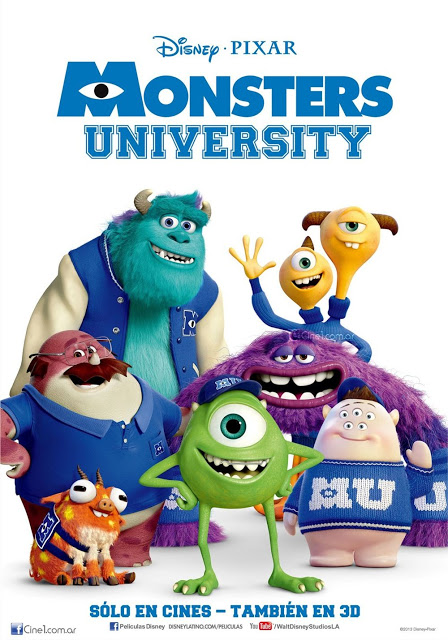
Finally, let's talk about Monsters University.  What a great film.  It's easy to come to expect greatness from Pixar, but with news that Finding Nemo is getting a sequel (a movie that is a lesser candidate for a sequel I can't imagine) it seemed as if Pixar had mined its creativity to exhaustion.  This proved that fear absolutely unfounded.  Sequels are hard, prequels harder (ahem . . . George).  Monsters University handled that challenge with aplomb and heart.  In fact, I was never really a fan of the first Monsters Inc., but this one seemed all the better.  And with Nathan Fillion as a voice actor, what's not to love?

Remarkably, the movie ended on a note that I hadn't expected.  In fact, as the credits started to roll the three year-old boy behind me turned to him mother and asked "why?"  She offered him a great explanation which I'll try to keep spoiler free.  Basically, "Because that's how it happens sometimes."  And she was right, and I left the movie feeling as though Pixar really had something to say; as much as they had an interest in entertaining three and thirty year-olds, they wanted us to reflect on how life actually is.  And they succeeded. 

Of all the movies I saw this weekend, Monsters University was the only one I recommend you see.  It was simply fantastic. 

Thursday, July 25, 2013

The Naked Soul . . . Or, Pathos and Catharsis In Film

What Dreams May Come always makes me cry.  If you haven't seen it, you need to.  Based on a Richard Matheson story (the same guy who wrote "I Am Legend," "The Shrinking Man," and "A Stir of Echoes") the film stars Robin Williams as a man whose love for his wife transcends Heaven and Hell and who turns his back on paradise to save her.  It is in my top ten films of all times, a list which includes tear-jerkers like Moulin Rouge and Top Gun.

In fact, as I reflect on my favorite movies, I realize that many of them contain moments of extreme pathos, moments when heroes fail, beloved characters die, or when someone makes a difficult decision which necessarily ends in tragedy.  Often the movie ends with success, but the journey is an emotional roller-coaster that makes the ending earned.  Earning the punchline is the hallmark of any good joke, and in film, stories, or any kind of narrative, the conclusion must be earned.  Otherwise the movie feels like a waste of time, regardless of the money poured into its special effects.

On that note, I've given some thought to what generates pathos -- what gives a story emotional depth and generates sorrow, pity, sympathy, or tenderness toward a character.

The first, and most vital ingredient, is a goal.  A concrete, identifiable goal is what defines a protagonist.  Think about Luke Skywalker: He wants to join the Rebellion to destroy the empire.  First, he has to leave his home, but his Aunt and Uncle won't let him.  After he receives his call to action by Obi-Wan, he departs on a mission to find the rebellion and deliver R2-D2 to them.  Once he's accomplished that mission, and found the rebellion, his initial goal is achieved.  But he still has to destroy the empire, symbolized in Episode IV by the Death Star.  Spoilers!  He accomplishes his goal.  But in the process he loses something important to him -- his mentor and friend, Obi-Wan Kenobi.

Just as important, Obi-Wan is killed while attempting to accomplish his own goals -- a goal he has in fact almost completed.  After disabling the tractor beam so that the Millennium Falcon can escape, he interposes himself between Darth Vader and Luke, enabling everyone to escape.  His sacrifice is what accomplishes that goal and we feel Luke's sorrow by being sad ourselves.

Writers sometimes talk about try-fail cycles.  In a traditional three-act structure, you see that nice arc that plunges at the end of the second act, and is completed in the third.  The protagonists concrete, identifiable goal is important because at the end of the second act, the protagonist should be as far as possible from accomplishing that goal.  In Star Wars the second act ends with Obi-Wan's death because he is Leia's "only hope."  With him gone, hope is gone, until we realize that now Luke has the Force and can destroy the Death Star, which, remember, was Luke's goal all along (even if he'd yet to discover it).

But for a reader or viewer to feel as though something has been accomplished, the characters cannot win every time.  In fact, each time they attempt something they should fail somehow.  When Luke goes in search of R2-D2, he's attacked and needs to be rescued.  Trying to feel Tatooine, Luke and Obi-Wan are interdicted by imperial Star Destroyers, they escape but when they reach Alderaan they are capture by the Death Star and so and so on.  They try, fail, have some success that enables them to try something else, they fail at that, try something else, and so on until the movie ends in victory.

Or consider Top Gun.  Maverick has only one goal: To be the best.  In the movie, this is symbolized in the concrete, identifiable goal of winning the Top Gun trophy.  We see him fail constantly in the classroom, in the air, and he is farthest from his goal just after Goose dies and he threatens to quit the program entirely.  Though he does not accomplish his goal of winning the trophy, we're offered a proxy goal of winning Ice Man's respect in the final battle with Soviet MiGs.

We as viewers feel these moments as deeply sorrowful because they advance both the plot and interfere with the protagonist's ability to achieve his concrete, identifiable goals.

The other form of pathos inducing action is the Noble Sacrifice in which a beloved character (usually other than the protagonist) sacrifices himself to save the protagonist, or our band of plucky heroes.  (Noble Sacrifices for abstract ideas or populations are much less noble because the viewer has difficulty developing affinity with abstract ideas or populations -- consider Armageddon in which Bruce Willis sacrifices himself for Ben Affleck: Though you could argue that he sacrifices himself to save the planet, it is clear that he does so in order to ensure his future son-in-law will survive to marry his daughter.  Or think about Neo choosing Trinity over humanity.)  In such cases it helps if the threat is external and has a definite end-point.  The classic is a ticking time bomb (such as the Genesis Device in Wrath of Khan, or someone diving on a grenade).

The final example I can think of is one of inevitability.  The protagonist cannot win.  Death is inevitable.  These cases, like British Officers on the Black Watch, teach us how to die.  In Deep Impact, facing the end, Tea Leoni's character stands with her father at the edge of the world and meets death with restraint and stoic courage.  The choice is what matters and we feel a profound sorrow in the realization that death is inevitable and that one day we may have to choose how to meet it.

In The Mist, Thomas Jane's character and his son finally escape the general store where they and most of the town have holed up; they've survived monsters in the mist and monsters of the human soul; but they've run out of gas and they can hear the monsters nearing.  With only enough bullets for his son, he makes the decision to spare his son a terrifying and gruesome death and shoots him in the head.  Death seemed inevitable and we're forced to make the same moral calculus as Thomas Jane's character.  Movies like this allow us to experience our own Kobiashi Maru every time we watch them, to challenge our own moral courage and our own values.

Wednesday, July 24, 2013

Ring of Fire . . . Or, Pacific Rim Review

So, caveat emptor.  Pacific Rim, Guillermo del Toro's newest and most commercial foray into the summer blockbuster is big, loud, dumb, and fun.  It was everything (literally) I expected, and not much else.  Suspend your disbelief walking in, otherwise it's just going to be irritating.  But once you realize that you're not really there to see something that makes logical sense, it's much more entertaining.  And since your brain has already been partially deactivated, it makes it that much easier to overlook the many plot holes, the abominable acting, the inept plotting, and utter lack of character.

This is a movie about big robots and bigger monsters.  It's a movie about destruction wholesale and not an ounce of emotion, pathos or humor.  Sure, there's some slap-stick, but it's so tied to overworn stereotypes and racial prejudice that it's simply banal.

But it's monsters.  And robots.  But while I enjoyed the fights -- which truly felt visceral -- I was never engaged in the characters, nor did I truly ever feel a sense of danger.  No one I cared about was ever truly in danger; cities, after years of assault by massive kaiju (Japanese for "really big monster") had gotten good at evacuating with little warning -- as a result, human populations were miraculously spared.  And our heroes (such as they are) were so two-dimensional -- no.  Strike that.  It wasn't that they simply lacked depth.  There was no there there.  They were dots on the screen that lacked arc, growth, or any conceivable motivation.  The only character with a hint of story was so maudlin that at times I wondered if she was just really good CG.

But the CG was amazing.  I never felt anything other than belief in the existence of these giant, incomprehensibly walking, fighting robots.  So normally I'd advise against seeing this type of movie, but the spectacle is so extraordinary that it has to be seen in the theater, if it has to be seen at all.  If you like the genre, I'm sure you'll enjoy this celluloidal romp.  If you don't like the genre, you'll probably still enjoy the wanton carnage.  It is the perfect amalgamation of Independence Day and Real Steel, that only demands you watch without a shred of intelligence or reflection.

While this movie has sometimes been advertised as science fiction, and del Toro announced that he wanted to make it a kind of Gothic sci-fi, it is neither Gothic nor science-fiction.  The technological mind-meld that del Toro asserts gives the movie its moral conflict is boring and utterly underutilized as a moral conflict.  Characters jump in and out of one another's minds with such ease that I wondered why it was even a big deal or even part of the story.  In fact, it's so easy to do that a human being can "drift" with a kaiju, demoting this particular McGuffin to irrelevancy.  But the whole movie is a McGuffin -- something which is explained with so much hand-waving that it devolves into farce, or the worst kind of fantasy.  Technology and science are so poorly understood that even a middle-schooler should be offended.  It was the worst kind of pandering.  (My favorite line [After a new Kaiju emerges bearing its own EMP and the functioning robots have been fried because of their digital systems our hero says of his robot]: "It's nuclear.  Analog."  Though, it's not quite as bad as this gem: "Let's do this!  Together!")

This is a moment, I suppose, to reflect on the dumbing down of our entertainment.  There's no reason this movie couldn't have had monsters, robots, plot and a decent character arc with a mediocre plot.  It would have required a director committed to making something other than schlock.  It would have required a half-way decent writer.  It would have required producers and a studio willing to take a risk.  But if The Lone Ranger and John Carter taught us anything, it's that studios are pretty willing to take risks.  So why don't they take the right risks?  Why don't they invest in something that isn't malto-meal for my eyes?

Just a few thoughts.

Bottom line, while I was entertained, it was cheap, mindless entertainment that I can't in good conscious recommend.  But hey, that's what summer movies are for, right? 

For comparison, here's a fan-girl review from Mary Sue that makes me wonder if we were watching the same movie.

Wednesday, July 17, 2013

This is the End?

Several times while watching "This is the End," Seth Rogen and Evan Goldberg's attempt at biting social commentary, I caught myself wondering, when will this end?  Never rising above crass physical comedy, pervasive drug and sexual humor, and mediocre satire, this movie seemed to never end.  Ostensibly about six friends trapped together during the Apocalypse (wearily confused with the Biblical rapture, in which Christians are taken bodily to Heaven), it is really a disjointed treatise on friendship, self-sacrifice, and what constitutes the "good life."

I literally suffered for this movie, riding my bicycle 22 miles to see it, and though that shouldn't affect my appreciation of the movie, it did.  While I wouldn't say that my money was stolen (I used a gift card, after all) I suspect that my time was wasted.  I was never really entertained, and listening to six actors self-referentially dissect their faults on screen, parodying or satirizing their own misbehavior, seemed boorish, at best.  At worst, it was simply tedious.  At 107 minutes long, it felt both rushed and never-ending.  The two minutes discursive about how one should or should not dispose of one's ejaculate ("I'll come wherever I want, Franco") was particularly distasteful.

But, you know, maybe this just isn't my scene.  As one character complains after being dragged to James Franco's house party, he would just rather be at home hanging out with his friend.  I can sympathize.  The competing visions of happiness at odds here are a kind of philosophical treatise.  On the one hand, the hedonism of James Franco house party (a wannabe starlet doing lines of coke off Michael Cera's ass was particularly telling) contrasted with the slacker existentialism of Jay Baruchel, who would rather get high and play video games while reconnecting with his estranged friend, Seth Rogen.

Interrupting this philosophical competition is the rapture, which snatches "those of good heart" into heaven, while leaving the rest (including our gang) trying to figure out what happened.  Added to the mix are demons and hell-spawn intent on eating, raping, and tormenting the remainder of humanity.  The movie is far from subtle, and its maladroit handling of human depravity, what it means to be good, or even the basic theological implications (as one character says, "This means there's a god.  I haven't been living as though there was") left me wondering what other people have been raving about.

Generally, the reviews have been positive.  Many people see in the film a calm reflection on the L.A. lifestyle, the superficiality of Hollywood, and a generally comment on the hollowness of modern life.  I don't see that at all.  I can see where the writers wanted to make those comments, but it was like watching someone pick gnats with boxing gloves on.  In general it was just embarrassing.

More distressing was the blatant mishandling of Biblical material -- far from the most egregious mishandlings of the Bible that I've ever seen, but painful nonetheless.  Willfully misrepresenting the opposition's argument isn't simply lazy, it's deceitful, and blatant plagiarism.  But juxtaposing this mishandling was a disturbing depiction of heaven that remains misogynistic and sexist.  Finally overcoming their selfishness through various acts of self-sacrifice, our heroes are bodily taken to heaven, where they are told whatever they can imagine will come about.

While this worked in "What Dream May Come," it fails here.  Insofar as our selfish characters have learned a token humility, they are incapable of imagining anything but petty pleasures.  Weed is of course obtainable in Heaven -- though one wonders why one would need to be high in Heaven.  But on top of that, women appear as bikini-clad sexpots, representations of their sexuality, and I had to wonder why the producers feel heaven is as sexually exploitative as their Hollywood existence.

This led me to suppose this is their idea of heaven.  By dressing heaven up as a white-linen-clad and somewhat foggy realm populated by the same vapid  characters as occupy their moral cesspool the producers have consciously chosen to reject a life of moral, philosophic, or intellectual perfection and substituted instead a sexually dominant paradigm that casually rejects individual liberties for more than half of humanity.  Even the message that one should reject selfish ambitions in order to achieve perfection is simply a parody meant to highlight the real message: that selfishness is in fact a worthy end in itself.

I found this movie abhorrent and would recommend it to no one.